
CJP’s “School Theek Karo” Campaign: Why Government Schools Have Become the Centre of a New Political Debate
RELEASED DATE: 31 August 2026
7 Minutes Read
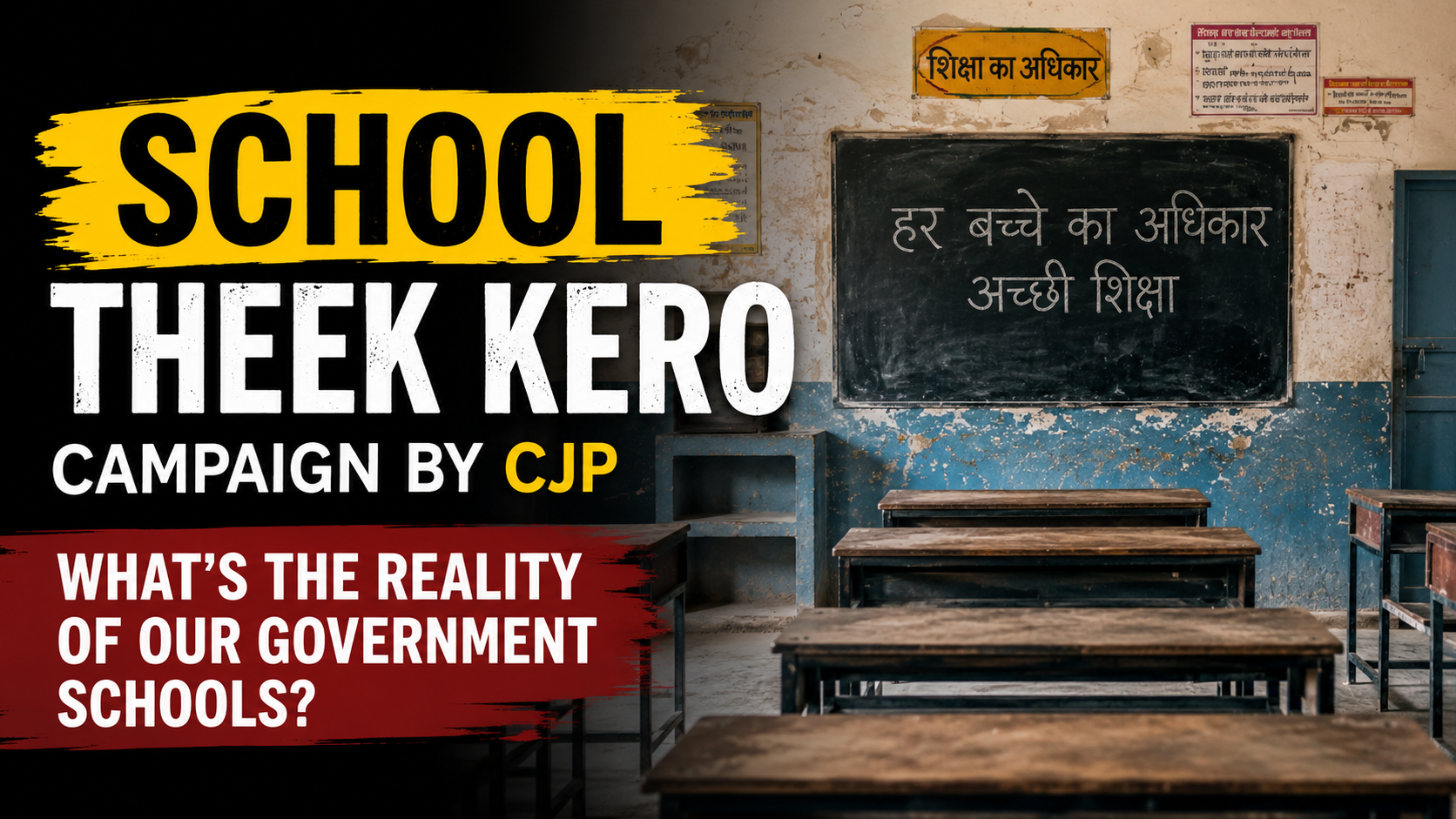
[AI generated image for showing as a thumbnail]
The “School Theek Karo” campaign launched by the Cockroach Janata Party (CJP) has quickly turned government-school conditions into a prominent political and public issue across several Indian states. The campaign was announced by CJP founder Abhijeet Dipke before its formal launch on Independence Day, with the stated aim of visiting government schools, documenting shortcomings and pressing authorities for improvements in infrastructure and basic facilities. CJP announced that the nationwide “School Theek Karo” campaign would begin on August 15, 2026, with a particular focus on rural government schools. [1] The first reported inspection took place at a school in Santuk Pimpri in Maharashtra’s Hingoli district, Dipke’s native village, where the campaign highlighted problems including a damaged window, sanitation concerns and a lack of basic facilities. TV9 Marathi reported that the campaign began at Santuk Pimpri in Hingoli on August 15 and that the visiting team raised concerns about the condition of the school building and toilet. [2] From there, the campaign expanded into other districts and states, with CJP volunteers examining school buildings, drinking-water arrangements, toilets, classroom conditions, teacher availability and mid-day meal facilities. The campaign has also generated disputes over whether political activists should be allowed to enter school campuses, interact with students and record videos without prior permission. That disagreement has become almost as prominent as the original infrastructure complaints, turning “School Theek Karo” into a debate not only about the condition of government schools but also about public scrutiny, privacy, administrative authority and political activism.
How the “School Theek Karo” Campaign Started
The campaign emerged from CJP’s broader political activity around education and public accountability. Before August 15, the party said it would send its founder and supporters into villages and speak with local representatives about the condition of government schools, rather than limiting the campaign to large urban demonstrations. Careers360 reported on August 12 that Abhijeet Dipke planned to launch the campaign on August 15 and said its initial focus would be rural schools and conversations with village leaders about infrastructure. [1] That approach gave the campaign a distinctly local character because the complaints were intended to come from individual schools instead of from a single statewide assessment. The first inspection at Santuk Pimpri quickly became the visual starting point for the campaign, with photographs and videos showing damaged infrastructure and sanitation-related concerns being circulated online. ABP Live reported that the first inspection raised questions about drinking water, benches and other basic facilities at the government school visited by Dipke in Hingoli. [3] CJP subsequently described the exercise as a type of citizen audit in which schools would be examined directly and problems would be placed before the administration. Over the following days, the campaign expanded geographically and increasingly focused on whether government schools were providing the minimum physical environment needed for children to study. By August 24, CJP was also seeking state-wise information on school infrastructure, teacher vacancies and funding, indicating that the campaign was moving from individual inspections toward demands for broader government data. Hindustan Times reported that CJP founder Abhijeet Dipke had written to education ministers seeking information on government-school infrastructure, teacher vacancies and funding. [4]
The First Major Attention Came From Maharashtra
Maharashtra became the natural centre of the campaign because that is where it began, and several inspections in the state generated strong political reactions. In Hingoli, the campaign's visit to Santuk Pimpri was followed by administrative action involving the school's headmaster, after allegations concerning his conduct and the school's functioning were raised. The Times of India reported that the Zilla Parishad school headmaster at Santuk Pimpri was suspended after allegations that he attended school drunk, while the report also mentioned demands for additional teachers and benches. [5] The suspension was an important moment for the campaign because it provided a visible example of an inspection being followed by official action, although it would be too simplistic to attribute every administrative decision solely to CJP because complaints from villagers and the department's own procedures were also involved. The campaign later moved to Latur district, where Dipke alleged that conditions at a Zilla Parishad Urdu school had been presented differently for his visit and claimed that students from another school had been brought into the premises. The Times of India reported that Dipke made allegations about a possible cover-up during a Latur school visit and also raised questions over the use of teachers for electoral-roll work. [6] The allegations surrounding the Latur visit were disputed, including by school authorities, making the episode a useful example of why the campaign's findings need to be separated into verified facts, allegations and responses from the people accused. The controversy became more serious when police registered an FIR against Dipke and associates over their entry into the school, with the complaint alleging unauthorised entry, filming students and disrupting school and government work. The FIR was registered at Ausa police station following a teacher's complaint, according to the Times of India report published on August 22. [7] The case has therefore added a legal dimension to what began as an education-focused campaign.
The Latur FIR Changed the Nature of the Debate
The Latur case is significant because it raises an issue that applies to almost every form of citizen monitoring: the difference between exposing a public problem and entering a controlled environment without permission. According to the police complaint reported by multiple outlets, Dipke and his associates entered a government school while classes were underway, interacted with students and recorded activities without authorisation. India Today reported that the FIR included allegations involving unauthorised entry, questioning students, obstruction of educational and official duties, and intimidation of staff. [8] CJP, however, has defended the purpose of the visit and argued that drawing attention to school conditions should not be treated as a crime. Dipke subsequently challenged the Maharashtra government to file cases against him if continuing to expose shortcomings in Zilla Parishad schools was considered unlawful. The Times of India reported on August 29 that Dipke said FIRs would not stop the “School Theek Karo” campaign and challenged the Maharashtra government over possible cases against him. [9] The disagreement shows why the campaign cannot be evaluated only through the question of whether government schools are in poor condition. There is a separate question about the method used to investigate those conditions, particularly where children are involved. A public school is funded by taxpayers and its performance should be open to accountability, but it is also a working educational environment containing minors, teachers and official records. That makes consent, privacy and authorised access important issues even when the underlying criticism is legitimate. The Latur case could therefore influence how future campaign teams carry out inspections and whether governments respond through formal inspection mechanisms rather than allowing confrontational visits to become the primary method of accountability.
Rajasthan Became the Campaign’s Biggest Policy Test
Rajasthan has become one of the most closely watched parts of the campaign because a dispute over school inspections was followed by a large government infrastructure announcement. The conflict intensified after CJP representatives visited a government school in Alwar's Thanagazi area and raised concerns about deteriorating infrastructure and the availability of drinking water. Hindustan Times reported that the Rajasthan government subsequently issued guidelines restricting the entry of outsiders into school campuses and prohibiting photography or videography without prior permission. [10] CJP criticised the guidelines as an attempt to restrict public scrutiny and said it would continue the campaign. The state government, on the other hand, presented the restrictions in the context of control over school campuses and the protection of students. The policy dispute became more significant when the Rajasthan government announced a three-year, approximately ₹12,500-crore roadmap for school infrastructure across the state's 41 districts. ThePrint reported that the Rajasthan government announced a roughly ₹12,500-crore three-year roadmap to rebuild school infrastructure across all 41 districts. [11] The plan reportedly covers school construction, repairs and other infrastructure needs, while separate digital-education proposals include smart classrooms and ICT facilities. The announcement has been politically linked to the timing of the CJP campaign, but it would be inaccurate to state as an established fact that the entire ₹12,500-crore programme was created solely because of CJP. Rajasthan officials had already been discussing school infrastructure and repair requirements, and political opponents have questioned how much of the announced funding represents new commitments compared with previously sanctioned work. Times of India reported that Congress questioned the funding structure of the ₹12,500-crore plan and cited government data showing schools without their own buildings, toilets or drinking-water facilities. [12] The more defensible conclusion is that the campaign increased public attention around school infrastructure while the government announced a major programme whose implementation will determine its eventual significance.
What the Rajasthan Numbers Tell Us
The infrastructure figures released amid the controversy are important because they show that the debate is not based only on a handful of viral videos. Government data cited by opposition leaders indicated that hundreds of schools were operating without their own buildings and that thousands of schools had gaps in basic facilities. According to the Times of India report, 611 schools were functioning without their own buildings, while 2,047 schools with buildings lacked toilets and 1,049 lacked drinking water. [12] The same report said the state had separately proposed 9,000 smart classrooms, 7,000 ICT labs and 80,000 tablets, with ₹1,087 crore earmarked for digital education by December 2026. Those numbers create an important policy question about priorities because technology upgrades are visible and politically attractive, but a smart classroom cannot compensate for a school without a functioning toilet or reliable drinking water. That does not make digital infrastructure unnecessary; it simply means that basic needs and modernisation have to be planned together rather than treated as competing political slogans. The government's three-year roadmap therefore matters less because of its headline amount and more because of whether funds are converted into functioning classrooms, safe buildings, sanitation facilities and regular services. CJP has questioned what progress had already been made before the announcement and has sought district-wise information on repairs and construction. A Rajasthan report published on August 25 said CJP spokesperson Ashutosh Ranka questioned how many schools had actually been repaired during the previous six months and sought details of completed works. [13] Those are reasonable questions for any infrastructure programme, regardless of which political party raises them, because public spending should ultimately be measured by completed work and improved outcomes rather than by the size of an announcement.
Marathwada Produced Some of the Most Striking Claims
The campaign's later work in Maharashtra produced another large set of figures concerning the condition of Zilla Parishad schools across Marathwada. A report published on August 30 said the campaign had identified thousands of classrooms and schools with serious infrastructure deficiencies, including damaged buildings, non-functional toilets, lack of electricity and shortages of benches and boundary walls. Free Press Journal reported that the campaign's preliminary data identified 7,107 Marathwada Zilla Parishad classrooms as being in dilapidated condition. [14] The same report cited campaign figures of thousands of schools without electricity connections or with connections that were not functioning, along with a large number of non-functional toilets. The same report said the survey cited 3,320 non-functional toilets, 1,625 schools lacking benches and 2,196 schools without boundary walls. [14] These numbers are significant, but the language used by the report is equally important: they are campaign-generated preliminary figures, not automatically the final official government inventory of every school in the region. A responsible reading therefore treats them as data points requiring verification rather than as unquestionable statewide statistics. Even with that qualification, the scale of the reported deficiencies is large enough to justify a formal government audit and public disclosure of school-wise infrastructure data. If official surveys confirm a similar scale of deterioration, the issue moves beyond politics and becomes a major public-infrastructure problem. If some figures are found to be inaccurate or based on different definitions of “dilapidated” or “non-functional,” the same verification process would still be useful because it would establish a common factual baseline. In that sense, the campaign's strongest long-term contribution could be the creation of a public demand for better school-level data.
Haryana Added Another Dimension
The campaign's expansion into Haryana showed that the issues were not limited to Maharashtra and Rajasthan. A government school in Bhiwani became the subject of a CJP video and subsequent administrative action after complaints concerning the school's mid-day meal arrangements and infrastructure were raised. The Times of India reported that a school in Bhiwani had its in-charge and a teacher suspended after a CJP video raised concerns about school meals and infrastructure, while two cooks were removed. [15] The report also described additional steps to maintain teaching and meal services at the school after the disciplinary action. What matters here is not simply the number of suspensions but the distinction between correcting individual misconduct and fixing the physical or administrative problems that allowed complaints to arise. If a school has inadequate sanitation or damaged classrooms, removing one employee will not solve the infrastructure problem. If a meal-safety complaint is genuine, changing staff may be necessary but food procurement, storage and monitoring also need attention. This is a recurring issue throughout the campaign: highly visible disciplinary action can happen quickly, while structural improvements take considerably longer. It is therefore possible for governments to appear responsive through immediate orders while the underlying school conditions remain unchanged for months. For parents and students, the latter is the more important measure.
A Campaign Can Expose a Problem, but It Cannot Repair a School by Itself
That distinction is important when judging what the CJP campaign has achieved so far. The campaign has undoubtedly succeeded in bringing school infrastructure into public conversation, and several governments have responded with inspections, disciplinary action, policy statements or funding announcements. CJP's own leadership has described these responses as evidence that authorities are being forced to confront the issue. Hindustan Times reported that CJP said several state governments had been compelled to respond to demands from young people for better government-school conditions, while also noting that the organisation considered its broader reform goal unfinished. [16] But a political campaign is only the beginning of an accountability cycle. After a school is shown to have a broken toilet, the next questions are who will repair it, where the money will come from, when the work will start and who will certify that it has been completed. The same applies to teacher shortages, drinking water, electricity and unsafe buildings. Without publicly verifiable follow-up, the campaign can generate attention without producing lasting change. Conversely, if governments publish school-wise action taken reports and independent observers can verify the improvements, the campaign could become a catalyst for measurable reforms. That is why the coming months will be more important than the first wave of social-media videos.
The Jaipur School Case Shows Why Follow-Up Matters
The campaign has continued to identify schools where the issue is not simply poor infrastructure but whether a functioning government school is being used at all. On August 30, a CJP team visited a government primary school in Jaipur's Bhatta Basti area and found the building locked. The building, according to reports, had been reconstructed after children were moved elsewhere, but the students had not yet been shifted back. The Statesman reported that the Bhatta Basti government primary school had remained locked after reconstruction and that the building had reportedly been rebuilt at a cost of ₹32 lakh. [17] The report also said that three teachers who had moved with the children to a neighbouring school had been absorbed into that school's staff strength. This example highlights a different type of public-school inefficiency: money can be spent on construction without the intended service actually returning to the community. A new building is only useful if children can enter it, teachers are available and the school operates normally. It also raises questions about coordination between infrastructure departments and education administrators. If a building is ready but remains unused for years, the issue is not simply construction quality; it is management. CJP's decision to focus on such cases is therefore potentially more useful when it moves beyond the photograph of a locked gate and asks for records showing when construction was completed, why the school was not reopened and who is responsible for the delay.
The Campaign Is Also Asking About Teacher Vacancies
Infrastructure is only one part of the education problem being raised by CJP. The organisation has repeatedly questioned teacher vacancies, arguing that a school cannot be considered functional simply because it has a building and a classroom. Hindustan Times reported that CJP sought state-wise data on teacher vacancies along with school infrastructure and funding information. [4] That demand is significant because teacher availability directly affects whether students can receive regular instruction, especially in rural schools where a small number of teachers may be responsible for several grades. A school can receive new desks, paint and digital equipment and still struggle if classrooms are understaffed. At the same time, teacher numbers have to be examined carefully because a simple vacancy figure does not reveal deployment, subject requirements, pupil numbers or whether teachers are temporarily assigned elsewhere. This is another area where reliable public data would improve the debate. Rather than arguing only over whether vacancies exist, governments could publish sanctioned posts, filled posts, vacancies, average student-teacher ratios and school-wise deployment information. Such data would make it possible to distinguish between an isolated shortage and a systemic staffing problem. CJP's demand for state-wise data could therefore become more useful if the campaign eventually pushes governments toward standardised disclosure rather than only political exchanges.
Mid-Day Meals Have Become Another Major Issue
Food served in government schools has also emerged as a recurring theme. During later visits to schools in Hingoli and other parts of Maharashtra, Dipke accused authorities of serving poor-quality or expired food to children and used the issue to question whether senior political leaders would accept the same standards for their own children. The Times of India reported on August 29 that Dipke raised allegations concerning expired food items during visits to Zilla Parishad schools in Hingoli and called for action over school conditions. [18] Such allegations are serious because food provided to children is directly linked to their health and safety, but they also require careful verification before being presented as established fact. A photograph of a food packet or ingredient does not by itself establish when it expired, who supplied it or whether it was actually served to students. Government inspection records, procurement documents and laboratory or food-safety findings provide stronger evidence. The same principle applies to claims about alcohol bottles, drugs or other prohibited activity being found on school premises. In one Latur case, for example, CJP made claims about liquor bottles and suspected substances, while the school principal disputed aspects of the allegations and provided a different explanation of the school's arrangement. NewsBytes reported that the principal denied CJP's allegations about “fake” students and clarified that Marathi- and Urdu-medium schools operated in the same building. [19] These disagreements demonstrate why a credible school-audit system needs evidence on both sides rather than relying entirely on either activist videos or official statements.
The West Bengal Incident Added a Serious Human Dimension
One of the most disturbing developments associated with the campaign occurred in West Bengal, where CJP said one of its volunteers came under attack after inspecting a government school and that the volunteer's father subsequently died. The incident has produced competing accounts about the circumstances of the death and the connection between the school campaign and the violence. Careers360 reported CJP's allegation that the father of its West Bengal volunteer Sheikh Abdul Hafiz had died after an attack and that the organisation demanded arrests. [20] Police and other reporting have provided additional details and disputed some descriptions circulating on social media, making it particularly important not to treat the political version of the incident as a final finding before the investigation is complete. The case nevertheless demonstrates that a local school inspection can become politically sensitive in areas where local rivalries and party politics are already tense. That makes safety planning essential for people participating in the campaign as well as for teachers, students and residents. It also shows the limits of treating every education dispute as a simple confrontation between activists and the government. There can be local actors, political workers and ordinary residents with their own interests, and the consequences can extend beyond the school itself. Whatever the final legal findings, the incident underlines the need for school-accountability work to be conducted through mechanisms that reduce the possibility of confrontation.
Why the Campaign Has Resonated With Young People
The campaign has gained attention partly because it connects education problems with a generation that spends a large amount of time consuming and sharing short-form political content online. Videos showing broken classrooms, poor sanitation or questionable food can communicate a problem in seconds in a way that a government audit report often cannot. CJP has also deliberately presented the campaign as a youth-driven exercise and has encouraged students and young volunteers to participate. Hindustan Times reported that CJP chief spokesperson Saurav Das urged youth and political leaders to join the “School Theek Karo” campaign during the organisation's August 24 meeting. [21] That strategy gives the campaign a wider emotional appeal because school conditions are a subject that most people can connect with from personal experience. At the same time, social-media visibility creates its own risks. A short video is good at showing a visible problem but usually cannot show the history of the school, its budget, staffing position, previous repairs or what the administration has already done. The most persuasive campaign therefore needs both the video and the underlying documentation. Without the latter, a viral post can become difficult to distinguish from political propaganda. With it, social media can become a powerful way to direct public attention toward verifiable evidence.
The Political Debate Is Growing Beyond CJP
The campaign is also beginning to draw responses from political figures who are not part of CJP. Opposition leaders have used the issue to criticise government education policies, while governments have responded with infrastructure announcements, inspections and administrative instructions. In Uttar Pradesh, for example, AAP MP Sanjay Singh said his party would continue a school-focused campaign and offered money for information about allegedly missing government schools in Jaunpur, while also referring to cases involving people who documented school conditions. Moneycontrol reported on August 24 that Sanjay Singh announced an AAP “School Theek Karo” campaign in Uttar Pradesh and linked it to videos and complaints about the condition of government schools. [22] This illustrates how quickly an issue can move beyond the political organisation that initially popularised it. Once school infrastructure becomes a politically useful subject, other parties have an incentive to adopt similar language and campaigns. That could be beneficial if it results in more public attention, but it can also make reliable data more difficult to distinguish from political competition. The strongest outcome would be for different parties to use the same independently verified school-level information and then compete over how quickly and effectively they can improve it. The weakest outcome would be a cycle in which every party releases its own selective videos and numbers without agreeing on what the actual conditions are.
What Should Happen After the Viral Videos?
The next logical step is a transparent, school-level verification process. If campaign groups identify a problem, the relevant education department can inspect it, publish the findings and specify what action is required. If a building is unsafe, there should be a documented structural assessment. If toilets do not function, the repair status should be recorded. If teachers are missing, the sanctioned and filled positions should be published. If a meal-quality allegation is made, the relevant procurement and food-safety checks should be documented. This would transform the political dispute into an auditable process where anyone can compare the original complaint with the government's response. The campaign's own demand for data could help create that process, provided it moves toward standardised evidence rather than treating every social-media claim as automatically correct. It would also give governments a way to respond without relying on political counter-statements. In the long run, the most useful “School Theek Karo” database would not merely list damaged schools; it would show the original condition, the responsible department, the allocated amount, the deadline, the completed work and the current status.
The Biggest Question Is Whether Announcements Become Results
The campaign has already produced enough political attention to make school infrastructure a visible issue in several states, but visibility is not the same thing as reform. Rajasthan's ₹12,500-crore roadmap is substantial on paper, yet the public will ultimately judge it through the number of schools repaired, classrooms rebuilt, toilets restored, water systems made functional and children returned to usable buildings. Maharashtra's mission-mode review and teacher and infrastructure discussions will face the same test. Haryana's administrative action after the Bhiwani school controversy will mean more if the underlying school receives sustained support rather than only disciplinary orders. The same is true of the Marathwada figures: if thousands of classrooms are genuinely unsafe, the important question is not how many were shown on video but how many are made safe and how quickly. That is also why the next stage of the campaign could be more difficult than its launch. Finding problems is relatively easy when the camera is running. Tracking repairs over months, obtaining records, checking whether work was actually completed and returning to the same schools is much harder. A campaign that succeeds at that second stage would have a stronger claim to being an accountability movement rather than simply a political media campaign.
What “School Theek Karo” Has Changed So Far
Within a little more than two weeks, CJP's “School Theek Karo” campaign has changed the conversation around government schools by moving individual problems from local communities into the national political and social-media space. It has highlighted alleged shortages involving water, toilets, benches, electricity, teachers, food and school buildings, while also forcing questions about how school inspection should be conducted. ThePrint's reporting from August 24 described the campaign as having expanded across several states and documented government responses in Maharashtra, Rajasthan, Haryana and elsewhere. [23] Governments have responded in different ways, including disciplinary action, restrictions on outsider access, reviews of education departments and major infrastructure announcements. At the same time, the campaign itself has faced legal and political pushback, most notably through the Latur FIR and disputes over school access and filming. The result is a movement that sits at the intersection of education policy, citizen accountability and political mobilisation. Whether it ultimately improves government schools will depend less on how many videos are uploaded and more on whether those videos lead to verified inspections, transparent spending and completed repairs. That is the point at which the campaign's slogan will either become a meaningful public accountability mechanism or remain primarily a political phrase. For the children actually sitting in those classrooms, the distinction will be simple: a school is “fixed” only when the building is safe, teachers are available, toilets work, drinking water is available, meals are safe and the school is genuinely capable of providing the education it is supposed to provide.
Sources
[1] Careers360 — CJP’s Abhijeet Dipke to launch ‘School Theek Karo’ campaign on August 15
https://news.careers360.com/school-theek-karo-campaign-cjps-abhijeet-dipke-want-votes-improve-schools-first-launch-on-august-15-independence-day-govt-rural
[2] TV9 Marathi — CJP launches nationwide ‘School Theek Karo’ campaign from Hingoli
https://www.tv9marathi.com/videos/cjps-abhijeet-dipke-initiates-nationwide-school-theek-karo-movement-from-hingoli-1734804.html
[3] ABP Live — First Hingoli school inspection and basic-facility concerns
https://www.abplive.com/states/maharashtra/abhijeet-dipke-cjp-school-theek-karo-campaign-hingoli-first-school-audit-government-school-poor-facilities-3175517
[4] Hindustan Times — CJP seeks state-wise school infrastructure and teacher-vacancy data
https://www.hindustantimes.com/india-news/cjp-vows-to-continue-fix-schools-campaign-after-rajasthan-govt-restricts-access-101786943500533.html
[5] Times of India — Hingoli Zilla Parishad school headmaster suspended
https://timesofindia.indiatimes.com/city/aurangabad/hingoli-zilla-parishad-school-headmaster-accused-of-attending-classes-drunk-suspended-ahead-of-dipke-return-to-district/articleshow/133303425.cms
[6] Times of India — Dipke alleges cover-up during Latur school visit
https://timesofindia.indiatimes.com/city/aurangabad/dipke-alleges-cover-up-of-school-deficiencies-during-latur-visit/articleshow/133384310.cms
[7] Times of India — CJP founder and associates booked over alleged unauthorised Latur school entry
https://timesofindia.indiatimes.com/city/aurangabad/cjp-founder-abhijeet-dipke-five-others-booked-for-unauthorised-entry-into-latur-school/amp_articleshow/133428655.cms
[8] India Today — FIR over alleged unauthorised entry into Maharashtra school
https://www.indiatoday.in/amp/india/video/fir-registered-against-cjp-founder-for-unauthorised-school-entry-in-maharashtras-latur-ytvd-2977709-2026-08-22
[9] Times of India — Dipke challenges Maharashtra government over possible cases
https://timesofindia.indiatimes.com/city/aurangabad/cockroach-janta-party-founder-dares-maharashtra-govt-to-file-cases-against-him-says-must-fix-schools/articleshow/133616821.cms
[10] Hindustan Times — Rajasthan restricts outsider access and unauthorised photography/video
https://www.hindustantimes.com/india-news/cjp-vows-to-continue-fix-schools-campaign-after-rajasthan-govt-restricts-access-101786943500533.html
[11] ThePrint — Rajasthan announces ₹12,500-crore school infrastructure roadmap
https://theprint.in/india/haryana-to-up-to-rajasthan-how-bjp-ruled-states-are-scrambling-amid-cjps-school-thik-karo-campaign/3023614/
[12] Times of India — Congress questions Rajasthan’s ₹12,500-crore school plan
https://timesofindia.indiatimes.com/city/jaipur/congress-calls-govts-12500-crore-school-plan-misleading-seeks-funding-breakup/articleshow/133473787.cms
[13] Tarun Bharat — Rajasthan’s three-year ₹12,500-crore school roadmap and CJP questions
https://m.tarunbharat.com/article/rajasthan-government-schools12500-crore-roadmap-bhajanlal-sharma-cjp-school-theek-karo/1635580/amp
[14] Free Press Journal — Marathwada school infrastructure figures reported during campaign
https://www.freepressjournal.in/education/7107-marathwada-zp-school-classrooms-in-dilapidated-condition-campaign-highlights-severe-infrastructure-crisis
[15] Times of India — Bhiwani school action after CJP video
https://timesofindia.indiatimes.com/city/chandigarh/bhiwani-school-in-charge-suspended-after-cjp-video-flags-school-meal-infra-lapses/articleshow/133429580.cms
[16] Hindustan Times — CJP says states responded to ‘School Theek Karo’ pressure
https://www.hindustantimes.com/india-news/it-doesn-t-end-here-cjp-claims-state-govts-had-to-bow-down-to-gen-z-101786552886831.html
[17] The Statesman — Jaipur government school found locked after reconstruction
https://www.thestatesman.com/india/cjp-team-visits-another-government-school-in-jaipur-under-school-theek-karo-campaign-1503632870.html
[18] Times of India — Dipke raises allegations over school food during Hingoli visits
https://timesofindia.indiatimes.com/india/do-ministers-feed-their-own-children-expired-food-abhijeet-dipke-during-school-thik-karo-campaign/articleshow/133611127.cms
[19] NewsBytes — Latur school allegations and principal’s response
https://www.newsbytesapp.com/news/india/inspection-uncovers-allegations-at-latur-school/story
[20] Careers360 — CJP allegation regarding West Bengal volunteer’s father
https://news.careers360.com/cjp-dipke-west-bengal-volunteer-father-dies-abdul-bjp-goons-attack-demand-attrest-x-video-online-school-theek-karo-latest-news
[21] Hindustan Times — CJP leadership urges youth participation in School Theek Karo
https://www.hindustantimes.com/india-news/cjp-meeting-today-live-update-cjp-nationwide-fresh-protest-neet-paper-leak-abhijeet-dipke-national-working-committee-bjp-101787544374134.html
[22] Moneycontrol — AAP’s school campaign in Uttar Pradesh
https://www.moneycontrol.com/news/india/aap-mp-sanjay-singh-offers-rs-1-lakh-to-find-five-missing-government-schools-in-up-s-jaunpur-14013402.html
[23] ThePrint — Multi-state response to CJP’s School Thik Karo campaign
https://theprint.in/india/haryana-to-up-to-rajasthan-how-bjp-ruled-states-are-scrambling-amid-cjps-school-thik-karo-campaign/3023614/
Authors
Want To Read Similar Posts

RELEASED DATE: 24 October 2026
READ TIME: 14 Minutes Read
October 2026 Security Alert: eMudhra Certificate Compromise, Node.js Vulnerabilities and PHP2Shell
October 2026 security alert: Learn about the eMudhra certificate compromise, Node.js vulnerabilities, PHP2Shell, patched versions and fixes.

RELEASED DATE: 17 October 2026
READ TIME: 7 Minutes Read
Tesla’s New Flying Car: Roadster 2, Features, Price, Launch Date and What Makes It Different
Explore Tesla's new flying car, the next-generation Roadster, its features, thruster technology, expected price, performance and launch date.

RELEASED DATE: 10 October 2026
READ TIME: 5 Minutes Read
US Suspends 8 Tech Firms From PERM: Full List and Impact
The US has suspended PERM processing for eight tech firms, including Microsoft, TCS and Infosys. Here's the full list and impact on green card applicants.

RELEASED DATE: 3 October 2026
READ TIME: 6 Minutes Read
What Documents Are Required to Sell a Property in Dubai?
Learn which documents are required to sell a property in Dubai, including title deeds, NOCs, mortgage papers, and legal requirements for sellers.

RELEASED DATE: 29 September 2026
READ TIME: 4 Minutes Read
Yo Yo Honey Singh Introduces Casa Tupka Tequila With New Music Release
Yo Yo Honey Singh launches Casa Tupka, a premium tequila brand made in Mexico, alongside his new music release Casa Tupka Anthemo.

RELEASED DATE: 27 September 2026
READ TIME: 10 Minutes Read
Vi’s Free International Roaming in 170+ Countries: What Changes for Customers and the Company
Vi has launched free international roaming in 170+ countries with selected plans. Here’s what changes for customers, Vi and Vodafone Idea shares.