
How to Choose the Perfect Business Name That Can Grow Into a Global Brand
RELEASED DATE: 5 September 2026
14 Minutes Read
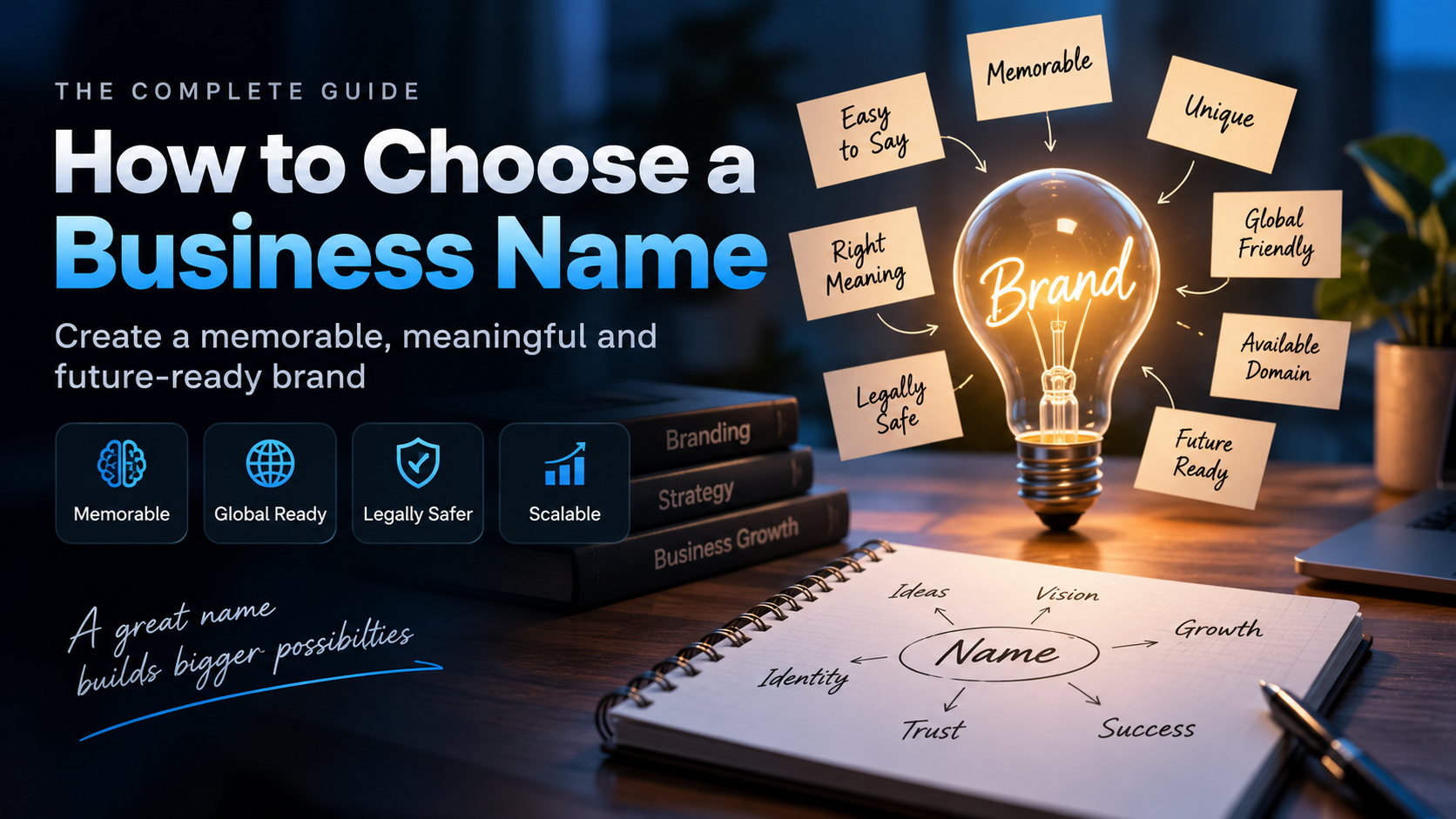
[Illustration showing key principles of business naming.]
A business name has a strange job. It has to work before anyone knows what the company does, yet eventually it becomes one of the things people use to recognise everything the company has built. That is why naming a business is harder than finding a word that sounds attractive. The name has to survive introductions, search boxes, email addresses, advertisements, legal documents, product launches and conversations where someone has heard it once and is trying to remember it later. A name can be meaningful without describing the business literally, and it can be completely invented while still feeling familiar enough to trust. The strongest names usually sit somewhere between those extremes: they are distinctive, easy to say, easy enough to remember and broad enough that the company does not outgrow them.
There is also a useful reality check for founders who spend too much time looking for a secret naming formula. There is no scientific rule that says a business becomes premium because it contains a particular set of letters. Research into sound symbolism does show that people can associate certain speech sounds with attributes and that these associations can influence brand preferences. Those effects have been observed across several languages, which is particularly interesting for companies thinking about international markets. But the research does not support a simplistic formula in which letters such as L, M, N or V are automatically better than harder consonants. The sound has to fit the product, the intended personality and the rest of the word.
Decide What the Company Needs to Become
Before creating names, decide what the company itself is likely to become. This sounds obvious, but it eliminates a surprising number of bad choices. A founder may launch a small software product, choose a highly descriptive name that works perfectly for the first version and then discover two years later that the company wants to sell several unrelated products. The name has quietly become a ceiling. A broader company name gives you more freedom to add products, enter new markets or change the business model without having to explain why the old name no longer describes what you do.
That does not mean every business needs an abstract name. A local plumbing company does not need the naming strategy of a global software company. A specialist firm can benefit from a descriptive identity because clarity may matter more than expansion. The point is to decide how much descriptive information should be built into the name and how much should be created later by the brand itself. A useful test is to imagine the company five years from now, not just on launch day. Write down the products or services you could realistically offer then. If your candidate still feels natural beside all of them, it has passed an important test.
Know What the Name Should Feel Like
There is a difference between what a name means and what it feels like. Two invented names can have no dictionary meaning at all and still create completely different impressions. One might feel technical and controlled, another calm and premium, and another energetic and playful. That impression comes from several things at once: sound, rhythm, spelling, familiar associations and the way the word looks on the page.
Sound symbolism research is useful here because it shows that speech sounds are not always perceived as arbitrary noise. Studies have found associations between phonetic properties and attributes such as softness, strength, size and other product characteristics, while international research has found that sound-symbolic fit can influence preferences across English, French, Spanish and Chinese-speaking participants. The practical lesson is not to copy a supposed “premium letter list.” It is to decide what personality your business needs and then listen to your candidates as words rather than judging them only as spellings.
A serious cybersecurity business may benefit from a name that sounds controlled and precise. A consumer design brand may want something warmer and more fluid. A logistics company may want movement and reliability. A financial company may prefer a sense of stability. The name should support that positioning instead of fighting it.
Use Phonetics as a Design Tool
The phonetic idea behind names such as Nokale, Avelis, Hemiel, Evolen and Valion is worth keeping, but the original formula needs one correction: there is no universal scientific category called “premium sounds.” Some sound patterns are associated with particular impressions, and those impressions can be useful when they fit the brand, but the effect is contextual. A 2022 systematic review found that higher-frequency sounds tended to be associated with higher evaluation and lower potency, while lower-frequency sounds were more strongly associated with lower evaluation and higher potency. That is very different from saying that one group of letters is inherently superior.
Your soft-tone approach can therefore be treated as a creative starting point. Vowels such as A, E and O can be used to create open transitions. Consonants such as L, M, N and V can produce smooth sequences in many combinations. Endings such as -le, -el, -en, -er, -is, -on or -um can change the cadence of a word. None of those endings guarantees a good business name, but they can help you explore a consistent sound family.
That is why Novale feels different from something abrupt like Krentax, even before either word means anything. Novale has a relatively open vowel sequence and easy transitions between sounds. Krentax contains a consonant cluster and ends abruptly. That may be exactly what a hardware-security company wants, but it is less aligned with the soft, polished character you described.
Build Names With Syllables, Not Random Letters
One of the easiest ways to create an artificial-sounding startup name is to start with a desirable letter and keep adding characters until a domain becomes available. A better approach is to think in syllables. Start with a simple spoken unit such as No, Lu, Ve, So, A, E or Va, then connect it to another unit that creates the intended rhythm. The word should first work in the mouth; the spelling comes second.
Your example Evolen illustrates the idea. It can be heard as a sequence of simple sound units rather than as an arbitrary six-letter string. Avenis works similarly because the consonant-vowel transitions remain easy to move through. Valion has a different feel because the ending creates a more formal cadence. That kind of construction is more defensible than simply saying “use V and L because they sound premium.”
The point is to make a new word feel as though it could have existed naturally. The audience should not have to watch you explain how the letters were assembled.
A Practical Naming Formula
For the style you are looking for, a useful working formula is:
Soft or open starter + simple connector vowel + distinctive middle sound + calm ending
You can build it in stages.
Step 1: Choose the opening. Start with an open vowel or a relatively smooth consonant such as A, E, O, V, L, M, N, S, H or W when that suits the brand.
Step 2: Add a connector. If the root sounds abrupt, use a, e, i or o to create a natural transition rather than forcing the root directly into the ending.
Step 3: Pick the middle character. This is where the name can acquire personality. A v can make the word feel sleek, an l can soften it, an m can make it warmer, and a more forceful consonant can add strength when that is desirable.
Step 4: Finish with a stable cadence. Endings such as -le, -el, -en, -er, -is, -on, -um can create different impressions. The final sound should make the whole word easier to say rather than sounding like a suffix pasted onto the end.
Step 5: Say it before writing the logo. If the word sounds awkward when repeated quickly, change the word. No visual identity can permanently fix an unpleasant spoken name.
This formula is not a law of branding. It is simply a disciplined way to generate candidates without drifting into random letter combinations.
Example: Turning a Hard Root Into a Softer Name
Suppose the business idea is built around synchronization. Sync is clear and relevant, but it ends with a sharp consonant and already belongs to a huge number of products and companies. Instead of adding another generic suffix, start by preserving the underlying idea while changing the spoken shape.
You might move from Sync to Syn, then test transitions such as Synelis, Symelis, Synel or Synova. From there, remove anything that feels awkward or too close to existing brands. Symelis, for example, has a much softer rhythm than the original root while still retaining a conceptual connection to synchronization. The point is not that Symelis is automatically a good company name. The point is that the process creates a word that can be evaluated on sound, meaning and distinctiveness rather than being trapped by the original literal term.
The same technique can be used with roots such as light, flow, network, value, cloud, motion or trust. Keep the idea, change the verbal form, then see which candidates remain natural after the meaning is no longer doing all the work.
Do Not Eliminate Hard Sounds Just Because They Sound “Unpremium”
Your original framework recommends avoiding hard starting letters and sounds such as K, T, P, G, D, B, R and X. That can be useful for the specific soft corporate aesthetic you want, but it should not become a universal naming rule. Research actually finds that different sounds can be associated with different kinds of brand attributes, and stronger or lower-frequency sounds can sometimes be appropriate depending on what the product is meant to communicate.
A cybersecurity platform may benefit from a firmer sound than a meditation application. A robotics company may want something energetic and mechanical. A luxury brand might choose a softer cadence. The correct question is not “Is this consonant harsh?” It is “Does this sound produce the character I want?”
That distinction prevents the naming system from becoming too narrow.
Test the Name Without Showing It
One of the most useful experiments is the hearing test. Tell someone the candidate name once without showing them the spelling, then ask them to write it down. Do the opposite afterward: show them the written name and ask them to pronounce it.
You are looking for friction. If someone hears Avenis and immediately writes Avenis, that is useful. If five people hear it and produce five spellings, the problem has nothing to do with your logo. It is built into the word. Research on brand-name processing has found that spelling and phonetic properties can influence memory, so this simple test is directly relevant to how a new name may be remembered after an initial encounter.
Repeat the test after ten minutes instead of immediately. The first test tells you whether the word was processed easily. The second tells you whether it stuck.
Put the Name Into a Sentence
A name that looks impressive in isolation may feel ridiculous when spoken naturally. Try phrases such as “I work at ___,” “We built ___,” “You can find it at ___,” and “Have you tried ___?” These sentences expose awkward rhythms very quickly.
This is especially useful with invented names because founders tend to judge them visually. A word may look excellent in a black-and-white logo while sounding clumsy in conversation. The reverse can also happen. A name that looks ordinary on screen may feel surprisingly memorable when spoken.
The best candidates work in both directions. They are easy to see and easy to say.
Search for the Name Before You Become Attached to It
This is the point where creative work meets legal reality. Search the candidate broadly before you start designing around it. Look for businesses, products, applications, domains, social accounts, news references and trademarks that are identical or similar.
An exact-match search is not enough. Trademark authorities can consider similarity in sound, appearance, meaning and overall commercial impression, particularly when the businesses operate in related markets. The United States Patent and Trademark Office explicitly explains that marks do not have to be identical for a likelihood-of-confusion problem to arise.
That means changing one letter is not a reliable strategy. Avenis may still need to be investigated against similar-sounding names even if no company uses exactly the same spelling.
The World Intellectual Property Organization's Global Brand Database is a useful starting point for this research, but WIPO also recommends checking national and regional trademark databases because no single database contains every relevant record.
Domain Availability Comes Later Than Most Founders Think
A free domain feels exciting because it creates the impression that the name is yours. It is not proof of that. Domain registration and trademark rights are separate issues.
The best order is to find a strong candidate first, then look for the cleanest practical domain. A slightly longer domain attached to a genuinely good brand can be more useful than a perfect short domain attached to a weak name. What matters is whether customers can hear the name, remember it and reach the correct company without confusion.
It is also worth searching common misspellings and similar domains. Someone who hears your company name and accidentally lands on another business because the spelling is unclear is experiencing a branding problem, even if no legal issue exists.
Test the Name in Different Languages
A name can sound excellent in English and create a completely different reaction elsewhere. That does not mean every international company needs to run a linguistic study across every language in existence. It means you should screen the languages that matter to the markets you actually intend to enter.
Research into sound symbolism is especially relevant here because studies have found that some phonetic associations can persist across languages. At the same time, the studies also show that preferences can vary, so a globally successful name should be evaluated rather than assumed to be universal.
Ask native speakers what the name sounds like to them. Ask what they think it means. Ask whether it resembles a familiar word, slang term or established brand. Avoid relying entirely on automated translation for this stage because the problem is often pronunciation or cultural association rather than literal meaning.
Check Whether the Name Can Carry a Large Company
Now imagine the name on things that have nothing to do with your current product. Put it on an annual report, an enterprise contract, a conference backdrop, a mobile app, an invoice, a press release and a recruitment page.
Then imagine the business becomes ten times larger.
A name like CloudInvoices may be perfectly good for a narrow software product. It becomes much less comfortable when the company starts selling security tools, payment infrastructure and developer software. An invented name such as Valion or Avenis provides more room because the company can define the word as it grows.
This is one reason scalable names often avoid locking themselves to a single function. The company eventually supplies the meaning.
Distinctive Does Not Mean Difficult
There is a temptation to make a name unusual simply so that it is easier to own as a domain or social handle. That can push founders toward strange spellings that create permanent customer friction.
There is a better form of distinctiveness: use a word shape that feels natural but is not already crowded. A candidate should be unusual enough to stand apart, but ordinary enough that people can pronounce it after seeing it once.
Research on brand names has repeatedly connected effectiveness with qualities such as distinctiveness, recognizability, pronunciation and avoidance of negative associations. The goal is therefore not to make people struggle to decode the name. It is to give them something that is easy to process and difficult to confuse with something else.
Examples From the Formula
Take Novale. The name has a relatively open beginning, a smooth internal transition and a calm ending. It also carries a faint association with “nova,” which can suggest something new without making the business category obvious. That gives the founder a conceptual story without forcing the brand to remain in one industry.
Lumiel has a different character. The association with light can create a useful conceptual direction for optics, clean technology or software without literally describing the product. The repeated liquid sounds make the word feel softer, although the actual impression will vary from listener to listener.
Evolen feels more active. Its sound suggests movement and evolution, which could fit logistics, software or data. The advantage is that it contains a conceptual hint while still functioning as an independent brand.
Vesperis is more formal. Its association with “vesper” gives it an established linguistic root, while the ending changes its overall cadence. This can work well for cybersecurity or enterprise infrastructure if the surrounding market does not already contain confusingly similar names.
Valion has an institutional quality. The relationship with “value” or “valor” is suggestive rather than literal, and the ending gives the word a more corporate rhythm. That could suit finance, enterprise software or security.
These examples demonstrate an important principle: a candidate does not need to be completely meaningless to become a strong brand. A light conceptual connection can help people form an initial impression while leaving enough room for the business to define the word over time.
Avoid Names That Already Belong to an Industry
This is one of the easiest traps to miss with sophisticated-sounding invented names. A name can feel fresh to you because you encountered it for the first time, while quietly being used by companies in pharmaceuticals, consulting, investment, software or manufacturing.
The more “corporate” the construction becomes, the more important this check becomes. Suffixes such as -is, -ia, -on, -um and -elis are attractive precisely because many businesses use similar patterns. That makes them useful building blocks but also increases the chance of overlap.
A good candidate should therefore be judged in the context of its industry, not just as a standalone word. Search the exact word, then search its closest phonetic relatives. If the results are crowded, move on even when you love the sound.
Think About Memory, Not Just First Impressions
People often evaluate names by asking, “Does this sound premium?” That is only the first second. A stronger question is, “Will someone remember it tomorrow?”
Memory is influenced by many factors, including distinctiveness, familiarity, pronunciation and the visual form of the word. Research on newly created brand names and spelling suggests that phonetic and orthographic properties can affect recall.
That is why a name like Kevale may be more useful than an arbitrary four-letter string. The latter may technically be unique, but it has less structure for the brain to hold onto. A pronounceable invented word can become distinctive without becoming cognitively expensive.
A Name Should Work Before the Logo Does
Do not let typography rescue a weak word. Founders often become excited after seeing a candidate rendered in a beautiful font and suddenly stop noticing that the name is awkward to pronounce. That reverses the order of importance.
First make the word work as plain text. Then make it work when spoken. Then make it work in an email address. Then turn it into a visual identity.
A strong business name should still feel reasonable in a basic sentence such as “You can find us at ___.” The logo is there to strengthen the name, not to disguise it.
When to Stop Searching
There is a point at which more options stop improving the decision. Once you have a small group of candidates that all satisfy the main strategic and linguistic requirements, additional brainstorming often creates noise rather than insight.
At that stage, compare the finalists on the things that actually matter: how naturally people say them, how reliably they spell them, how distinct they are in the market, whether the name can support future products and whether there is a realistic path to trademark protection. A name that wins across those constraints is usually a better business decision than the name that simply produces the strongest emotional reaction from its founder.
The goal is not to discover a word that everybody loves instantly. The goal is to find a word the company can own, explain, remember and grow into.
The Final Test: Could This Become the Name of a Twenty-Five-Year-Old Company?
The best candidates should survive time. Imagine the company after twenty-five years, when the people who discovered it at launch may no longer be the people running it. The product may have changed. The market may have changed. The company may operate in countries you never considered when you first started.
The name should not depend on today's slang, a temporary technology trend or a narrow description of the original product. It should still sound natural when spoken by someone who has no knowledge of the original naming story.
That is where your idea of a timeless ending becomes useful. Not because -le, -en, -is or -on are universally superior, but because a controlled cadence can make an invented name feel less disposable. The research supports thinking about phonetic fit; the rest has to come from strategy and testing.
A business name does not need to predict the future. It needs to leave enough room for the future to happen.
The Naming Formula in One Working Example
Suppose the brand concept is an enterprise platform built around synchronization, automation and dependable infrastructure. The raw word “Sync” is useful conceptually but not ideal as the final brand because it is short, crowded and ends sharply.
Start with Syn.
Add a connector vowel: Syna, Syne, Syni, Syno.
Introduce a softer middle: Syna + ve, Syne + li, Syno + val.
Then experiment with the ending: Synelis, Synovia, Symelis, Synavel.
Now stop generating and start testing. Which version can people pronounce without help? Which one can they spell after hearing it? Which one sounds natural in “I work at ___”? Which one remains flexible if the company expands into another product? Which ones survive a trademark search? Which one looks distinctive without needing unusual capitalization?
That final stage is where naming becomes business work instead of wordplay.
Authors
Want To Read Similar Posts

RELEASED DATE: 24 October 2026
READ TIME: 14 Minutes Read
October 2026 Security Alert: eMudhra Certificate Compromise, Node.js Vulnerabilities and PHP2Shell
October 2026 security alert: Learn about the eMudhra certificate compromise, Node.js vulnerabilities, PHP2Shell, patched versions and fixes.

RELEASED DATE: 17 October 2026
READ TIME: 7 Minutes Read
Tesla’s New Flying Car: Roadster 2, Features, Price, Launch Date and What Makes It Different
Explore Tesla's new flying car, the next-generation Roadster, its features, thruster technology, expected price, performance and launch date.

RELEASED DATE: 10 October 2026
READ TIME: 5 Minutes Read
US Suspends 8 Tech Firms From PERM: Full List and Impact
The US has suspended PERM processing for eight tech firms, including Microsoft, TCS and Infosys. Here's the full list and impact on green card applicants.

RELEASED DATE: 3 October 2026
READ TIME: 6 Minutes Read
What Documents Are Required to Sell a Property in Dubai?
Learn which documents are required to sell a property in Dubai, including title deeds, NOCs, mortgage papers, and legal requirements for sellers.

RELEASED DATE: 29 September 2026
READ TIME: 4 Minutes Read
Yo Yo Honey Singh Introduces Casa Tupka Tequila With New Music Release
Yo Yo Honey Singh launches Casa Tupka, a premium tequila brand made in Mexico, alongside his new music release Casa Tupka Anthemo.

RELEASED DATE: 27 September 2026
READ TIME: 10 Minutes Read
Vi’s Free International Roaming in 170+ Countries: What Changes for Customers and the Company
Vi has launched free international roaming in 170+ countries with selected plans. Here’s what changes for customers, Vi and Vodafone Idea shares.