
Google Workspace vs Microsoft 365 vs Zoho Mail: Which Is Best for Your Business?
RELEASED DATE: 22 September 2026
10 Minutes Read
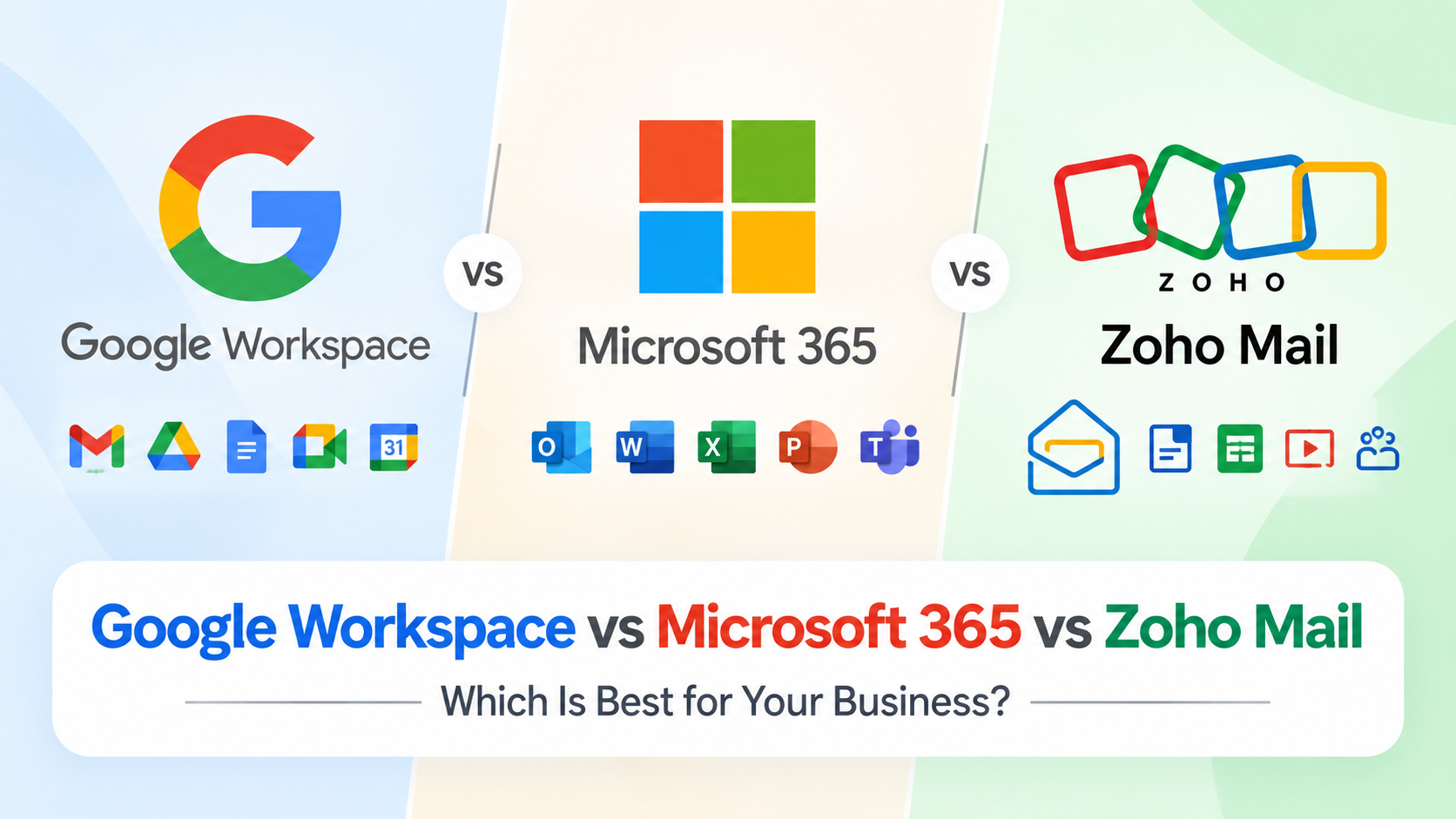
[Illustration image showing comparison between Google Workspace, Microsoft 365 and Zoho Mail]
Choosing a business email service looks simple until you actually compare the three names most companies come across: Google Workspace, Microsoft 365 and Zoho Mail.
All three can give you an email address using your own domain, but they are built around slightly different ways of working. Google Workspace puts Gmail, Drive and Google’s browser-based productivity tools at the centre. Microsoft 365 is the natural fit for businesses that depend on Word, Excel and PowerPoint, particularly on desktop. Zoho Mail starts with email and can be expanded into the wider Zoho Workplace suite.
For a small business that mainly works online, needs professional email and spends a lot of time in browser-based documents, Google Workspace is the option I would choose. Microsoft 365 makes more sense when desktop Office applications are an important part of everyday work. Zoho becomes particularly interesting when keeping the cost of business email low is a major consideration.
Google Workspace
Google Workspace is built around a set of services that many people already use separately. With Business Starter, Google provides custom business email through Gmail, 30 GB of pooled storage per user and Google Meet for meetings with up to 100 participants. Higher plans increase storage to 2 TB and 5 TB per user and add features such as meeting recording, Google Vault and expanded administration. Google also includes Gemini features across the Workspace experience.
The biggest advantage is the way the services fit together. Gmail, Drive, Docs, Sheets, Slides, Calendar and Meet all live inside the same ecosystem. A document can be shared from Drive, edited by several people and discussed without moving between completely different platforms. For a small team that spends most of its time in a browser, that setup is hard to make complicated.
Google's current standard Business Starter price is $7 per user per month on an annual commitment, with higher prices for the Standard and Plus plans. In India, Google currently displays local pricing on its business page, with the exact amount depending on the billing option and applicable taxes.
Microsoft 365
Microsoft 365 feels different because its centre of gravity is still the traditional Office environment. Business Basic includes custom email, Outlook, web and mobile versions of Word, Excel and PowerPoint, Teams and 1 TB of OneDrive storage per user. Business Standard adds the desktop versions of the Office applications.
That desktop distinction is important. Someone who regularly works with complex Excel files, Word documents or PowerPoint presentations may have little reason to move away from Microsoft's ecosystem. The applications are familiar, and the subscription keeps the desktop software connected with cloud storage and collaboration.
Microsoft also changed its business pricing in 2026. The standard US annual price for Business Basic is now $7 per user per month, while Business Standard is $14 per user per month. Microsoft lists separate pricing for plans sold without Teams. In India, Microsoft currently lists Business Basic at ₹170 per user per month when paid yearly, with GST charged separately.
There is another practical difference for a business owner: a Business Basic subscription is not the same thing as buying the full desktop Office experience. The plan includes web and mobile apps, while Business Standard is the plan that brings desktop Word, Excel, PowerPoint and Outlook into the package.
Zoho Mail
Zoho takes a different route. You can buy Zoho Mail on its own, or use Zoho Workplace when you also want documents, spreadsheets, presentations, file storage and team communication.
The current Zoho Mail pricing is considerably lower than the entry-level plans from Google and Microsoft. Mail Lite starts at $1 per user per month billed annually for 5 GB of mail storage, with a 10 GB option at $1.25. Mail Premium is $4 per user per month with 50 GB of mail storage.
Zoho Workplace Standard is $3 per user per month billed annually. It includes 30 GB of mail storage per user along with WorkDrive, Writer, Sheet, Show, Cliq and Meeting. Workplace Professional is $6 per user per month and increases mail storage to 100 GB while expanding the collaboration and storage package.
There is even a free Zoho Mail plan for up to five users in selected data centres. It provides 5 GB of mail storage per user for one domain, although IMAP, POP and ActiveSync are not included in that free edition.
For a small company that mainly wants addresses such as hello@company.com, support@company.com and admin@company.com, Zoho can therefore be much cheaper than paying for a complete productivity suite.
Google Workspace vs Microsoft 365 vs Zoho Mail
Feature | Google Workspace | Microsoft 365 | Zoho Mail / Workplace |
|---|---|---|---|
Custom business email | Yes | Yes | Yes |
Main email app | Gmail | Outlook | Zoho Mail |
Cloud storage at entry business plan | 30 GB pooled per user | 1 TB per user | 5 GB with Mail Lite; 30 GB with Workplace Standard |
Office documents | Docs, Sheets, Slides | Word, Excel, PowerPoint | Writer, Sheet, Show |
Desktop Office apps | No | Yes with Business Standard | Zoho desktop/web apps |
Video meetings | Google Meet | Teams | Zoho Meeting |
AI tools | Gemini | Microsoft AI/Copilot features vary by plan | Zia |
Entry annual price | $7/user/month | $7/user/month | $1 Mail Lite or $3 Workplace Standard |
Best suited to | Browser-first businesses | Office-heavy businesses | Budget-conscious email and productivity |
Prices shown are current listed prices and can vary by country, taxes, billing commitment and plan configuration.
Which One Should You Choose?
For a small business, startup, website or content operation, Google Workspace is the most balanced choice when most work happens online. Gmail is familiar, Drive gives you a straightforward place for files and the combination of Docs, Sheets, Meet and Calendar covers the everyday tasks without requiring a complicated setup. Google also puts Gemini directly into several Workspace products.
Microsoft 365 is the better fit for a business where Word, Excel, PowerPoint and Outlook are not optional extras but part of daily work. The difference becomes particularly clear when desktop Office applications matter. Business Standard includes those desktop versions along with email, OneDrive and Teams.
Zoho makes the most sense when business email is the priority and you want to keep the bill down. You do not have to buy an entire productivity package just to get a domain-based mailbox. Mail Lite starts at $1 per user per month on annual billing, while Workplace Standard adds the broader productivity suite for $3.
There is also a useful option for businesses that are already paying for one of these services and are considering a move. Zoho provides migration tools for Google Workspace and Microsoft 365, including migration of email and other supported data.
One thing should not be overlooked when comparing these services: business email is only one part of the subscription. If you only need email, paying for a full office suite may be unnecessary. On the other hand, saving a few dollars on email can become a false economy when your team later needs document collaboration, shared storage, meetings or desktop Office software.
For that reason, I would make the choice this way: Google Workspace for a browser-first business, Microsoft 365 for an Office-first business, and Zoho Mail for a business that wants professional email at a lower entry cost. For a small online business where email, documents, file sharing and day-to-day collaboration all matter, Google Workspace would be my pick.
Frequently Asked Questions
1. Which is cheaper, Google Workspace, Microsoft 365 or Zoho Mail?
Zoho is the cheapest at the entry level. Mail Lite starts at $1 per user per month when billed annually, while Google Workspace Business Starter and Microsoft 365 Business Basic are both listed at $7 per user per month on annual commitments in their standard US pricing.
2. Is Microsoft 365 the same as Office 365?
Microsoft 365 is the current name for Microsoft's broader subscription offering. The business plans include services such as Outlook, Word, Excel, PowerPoint, Teams and OneDrive depending on the plan.
3. Does Google Workspace include Gmail?
Yes. Google Workspace business plans provide custom business email through Gmail, so you can use addresses on your own domain.
4. Does Microsoft 365 Business Basic include desktop Word and Excel?
No. Business Basic includes the web and mobile versions of Word, Excel, PowerPoint and Outlook. Desktop applications are included with Business Standard and higher plans.
5. Can I use my own domain with Zoho Mail?
Yes. Zoho Mail supports custom domain email, including addresses such as name@yourcompany.com.
6. Which one is best for a one-person business?
For someone who needs email, documents, storage and meetings in one place, Google Workspace is a convenient choice. If the requirement is mainly professional email at the lowest possible cost, Zoho Mail can be sufficient.
7. Which is better for Excel?
Microsoft 365 is the natural choice when Excel is a major part of the job, particularly when you need the desktop application. Business Standard includes desktop Excel.
8. Can I move from Google Workspace to Zoho Mail?
Yes. Zoho provides migration support for Google Workspace and can migrate email and other supported data during the move.
9. Can I use Zoho Mail without buying Zoho Workplace?
Yes. Zoho sells Mail Lite and Mail Premium separately. Workplace is the larger bundle that adds applications such as Writer, Sheet, Show, WorkDrive, Cliq and Meeting.
10. Which one should I choose for my business?
Choose Google Workspace when most of your work is online and collaboration is important. Choose Microsoft 365 when desktop Office applications are central to your workflow. Choose Zoho Mail when professional email is the main requirement and keeping costs low matters most.
Authors
Want To Read Similar Posts

RELEASED DATE: 24 October 2026
READ TIME: 14 Minutes Read
October 2026 Security Alert: eMudhra Certificate Compromise, Node.js Vulnerabilities and PHP2Shell
October 2026 security alert: Learn about the eMudhra certificate compromise, Node.js vulnerabilities, PHP2Shell, patched versions and fixes.

RELEASED DATE: 17 October 2026
READ TIME: 7 Minutes Read
Tesla’s New Flying Car: Roadster 2, Features, Price, Launch Date and What Makes It Different
Explore Tesla's new flying car, the next-generation Roadster, its features, thruster technology, expected price, performance and launch date.

RELEASED DATE: 10 October 2026
READ TIME: 5 Minutes Read
US Suspends 8 Tech Firms From PERM: Full List and Impact
The US has suspended PERM processing for eight tech firms, including Microsoft, TCS and Infosys. Here's the full list and impact on green card applicants.

RELEASED DATE: 3 October 2026
READ TIME: 6 Minutes Read
What Documents Are Required to Sell a Property in Dubai?
Learn which documents are required to sell a property in Dubai, including title deeds, NOCs, mortgage papers, and legal requirements for sellers.

RELEASED DATE: 29 September 2026
READ TIME: 4 Minutes Read
Yo Yo Honey Singh Introduces Casa Tupka Tequila With New Music Release
Yo Yo Honey Singh launches Casa Tupka, a premium tequila brand made in Mexico, alongside his new music release Casa Tupka Anthemo.

RELEASED DATE: 27 September 2026
READ TIME: 10 Minutes Read
Vi’s Free International Roaming in 170+ Countries: What Changes for Customers and the Company
Vi has launched free international roaming in 170+ countries with selected plans. Here’s what changes for customers, Vi and Vodafone Idea shares.