
Anthropic Launches Claude Fable 5.1 and Mythos 5.1 With Major Gains in Coding and AI Research
RELEASED DATE: 2 September 2026
7 Minutes Read
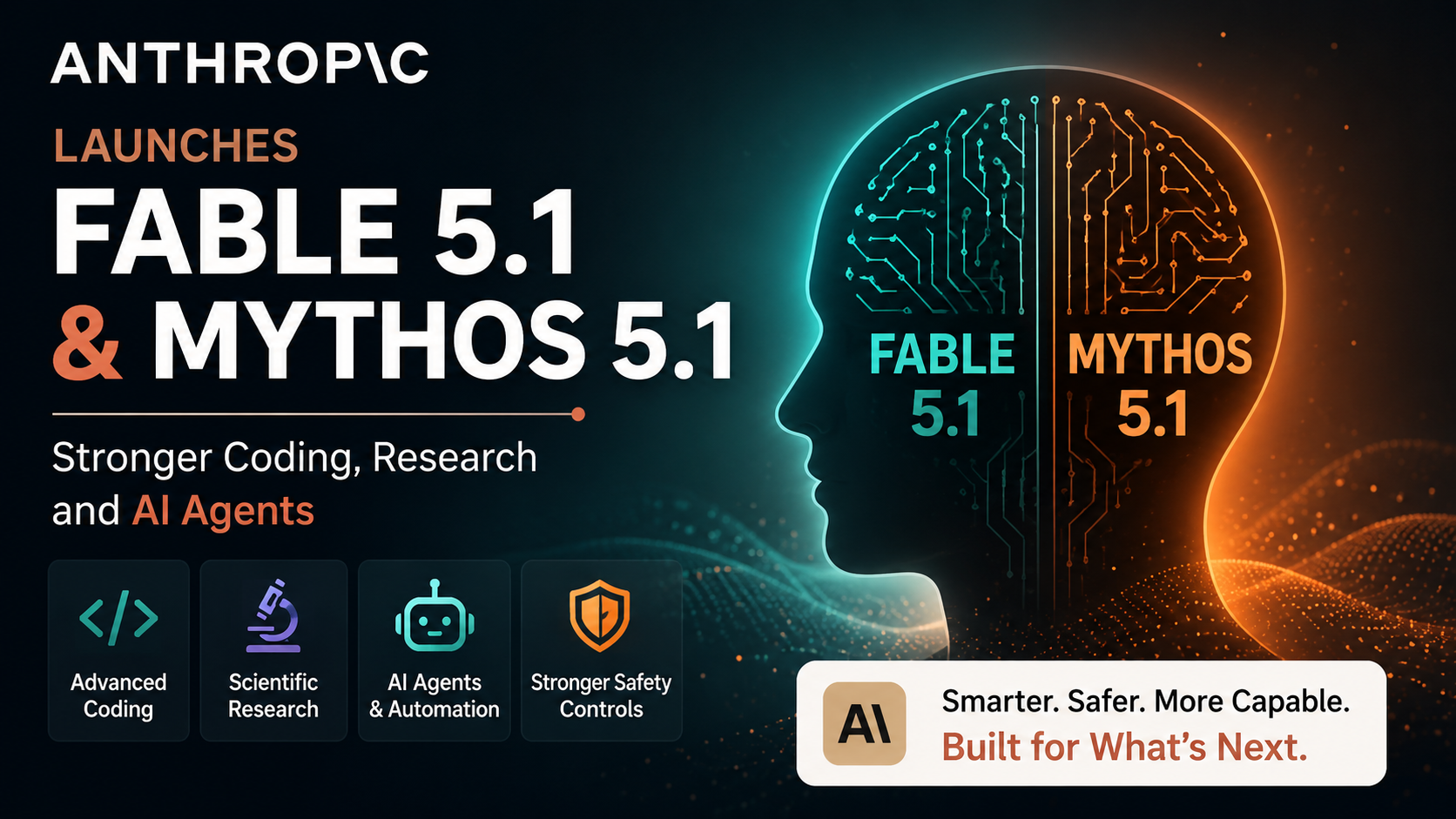
[Illustration showing Anthropic’s launch of the new Fable 5.1 and Mythos 5.1 AI models.]
Anthropic has introduced Claude Fable 5.1 and Claude Mythos 5.1, two new AI models aimed at pushing Claude further into advanced coding, long-running agentic work, scientific research, cybersecurity and other demanding knowledge tasks. The announcement, made on September 1, 2026, comes only a few months after the previous Fable 5 generation, but this release is more than a simple model-number upgrade. Anthropic is presenting Fable 5.1 as its most capable generally available model, while Mythos 5.1 is being kept behind restricted access for organizations working in sensitive areas such as cybersecurity and life sciences.
What makes the release particularly interesting is that Fable 5.1 and Mythos 5.1 are based on the same underlying model, but they operate with different safeguards. Anthropic has essentially separated the general-purpose version from the higher-risk version instead of exposing the full capability set to everyone. This approach allows the company to make substantial improvements available to developers and businesses while keeping some of the model's more sensitive capabilities limited to vetted organizations.
Claude Fable 5.1 Focuses on Long-Running AI Work
Anthropic is positioning Fable 5.1 for tasks that require much more than answering a single prompt. The company describes it as being designed for demanding reasoning and long-horizon agentic work, where an AI system may need to work through multiple steps, use tools, inspect results, correct mistakes and continue toward a larger objective.
This is becoming an important direction for AI development. Earlier generations of assistants were largely optimized around conversations, code generation and short tasks. Newer models are increasingly being designed to operate more like autonomous workers that can investigate a problem, execute a sequence of actions and return with a completed result. Fable 5.1 is clearly part of that transition.
The model has a 1 million-token context window and supports up to 128,000 tokens of output, while adaptive thinking is always enabled. Anthropic is also keeping its standard Fable 5.1 API pricing at $10 per million input tokens and $50 per million output tokens, although the company has substantially reduced the price of reading cached context.
Fable 5.1 Shows a Large Jump on Scientific Research Tasks
One of Anthropic's most notable reported results comes from Terminal-Bench-Science 0.1, a benchmark designed around agentic scientific research tasks. Fable 5.1 achieved 52.6%, compared with 24.7% for Fable 5 and 29.0% for Opus 5 in Anthropic's evaluation setup.
That is a significant jump over its predecessor, although benchmark numbers should still be viewed in context because they represent Anthropic's own evaluation methodology rather than a universal measurement of intelligence. The result is nevertheless important because it reflects the direction Anthropic is pursuing: AI systems capable of handling longer research workflows rather than simply answering scientific questions.
On Terminal-Bench 4.0, which focuses on agentic coding through terminal-based tasks, Anthropic reports 55.8% for Fable 5.1, compared with 42.0% for Fable 5 and 52.3% for Opus 5. Mythos 5.1 reached 60.9% under its more permissive cybersecurity safeguards.
Mythos 5.1 Is the More Restricted Version
The biggest difference between the two models is not their underlying intelligence but how much of that capability can be exposed to users.
Mythos 5.1 is intended for advanced cybersecurity and biology research and is available only to a limited group of vetted organizations through Anthropic's trusted-access programs. The company says the model is powerful enough in areas such as cybersecurity and biology that unrestricted access could create significant risks.
This is why Mythos 5.1 isn't simply being released as another consumer-facing Claude model. Anthropic is using verification programs to control access to the model and is gradually expanding who can work with these capabilities.
The distinction is particularly important because advanced AI can have dual-use capabilities. A model that can help researchers understand a biological problem or identify a security weakness could potentially be misused if the same capabilities were exposed without appropriate restrictions.
Fable 5.1 Brings More Precise Safety Controls
Anthropic has also changed how safety restrictions work in Fable 5.1. Instead of simply making the model broadly incapable of working on sensitive subjects, the company says its safeguards are becoming more precise.
For example, Fable 5.1 can now be used to identify software vulnerabilities in source code, while Anthropic continues to restrict more dangerous cybersecurity activities such as penetration testing and exploit generation. In biology, Anthropic says its newer safeguards intervene on benign requests far less frequently than the safeguards introduced with the previous Fable 5 generation.
This is an important part of the release because AI safety is increasingly becoming a product-design issue rather than something that happens only during model training. Anthropic is effectively trying to create a model that can remain useful for legitimate technical work without making the most dangerous capabilities freely available.
75% Cheaper Cache Reads Could Matter for AI Agents
Another major part of the Fable 5.1 launch is not about benchmark performance at all. Anthropic has reduced the price of cache reads by 75%, bringing them down to $0.25 per million tokens while keeping the regular input and output pricing unchanged.
That may sound like a technical pricing adjustment, but it could become important as AI agents start operating for longer periods. Long-running agents repeatedly work with large amounts of context, previous results, instructions and tool information. If developers have to repeatedly pay the full price to process the same information, operating these systems can become expensive.
Lower cache-read pricing gives developers more room to maintain persistent context without paying the same cost every time. Anthropic says this can reduce the overall cost of typical workloads by around 25% and highly agentic workloads by as much as 45%, depending on how the system uses caching.
For companies building AI agents, this may ultimately be just as important as the model's benchmark improvements.
Fable 5.1 Is Designed for More Than Coding
Although coding is one of the main areas highlighted in the release, Anthropic is also targeting broader knowledge work. The company reports improvements across document, spreadsheet and presentation tasks, along with scientific research and complex reasoning.
This reflects how enterprise AI is changing. Businesses are increasingly interested in systems that can move between different types of work instead of having one AI model for coding, another for research and another for document processing.
A capable agent could potentially inspect a dataset, write code to analyze it, generate a report, prepare a presentation and then explain the findings. The challenge is no longer just whether an AI can perform each individual task. The bigger question is whether it can coordinate the entire workflow reliably.
What Does This Mean for Claude Users?
For ordinary Claude users, the most important point is that Fable 5.1 is the generally available model, while Mythos 5.1 remains restricted. Developers can access Fable 5.1 through Anthropic's API and supported cloud platforms, while Mythos access depends on Anthropic's verification programs.
Fable 5.1 is not necessarily designed to replace every Claude model for every workload. Anthropic's own documentation recommends Opus 5 for many workloads and positions Fable 5.1 for situations where stronger reasoning or longer-running agentic performance is required.
That makes the model more of a high-end option for difficult tasks rather than simply a universal replacement for everything else in the Claude lineup.
Why This Launch Matters for the AI Industry
The interesting part of Fable 5.1 and Mythos 5.1 is not just that Anthropic has released another stronger model. The larger story is that AI companies are moving toward specialized capability levels and controlled access.
At one end, there are models designed for everyday users and common business tasks. At the other end, there are increasingly powerful systems capable of advanced cybersecurity, scientific research and complex autonomous workflows. Companies now have to decide not only how capable a model should be, but also which capabilities should be available to which users.
Anthropic's decision to release Fable 5.1 broadly while keeping Mythos 5.1 restricted shows how seriously that problem is being treated. It also suggests that future AI releases may increasingly be differentiated by safety configuration and access level rather than by completely different underlying models.
For developers, the other major takeaway is that AI agents are becoming the center of the competition. Bigger context windows, lower caching costs, stronger tool use and better long-running reasoning are all pieces of the same strategy: making AI capable of completing substantial projects instead of simply responding to individual prompts.
Anthropic's Fable 5.1 and Mythos 5.1 therefore represent another step in that shift. The competition is no longer only about which chatbot gives the best answer. It is increasingly about which AI system can take a difficult objective, work through it for a long time, use the necessary tools and actually get the job done.
Authors
Want To Read Similar Posts

RELEASED DATE: 24 October 2026
READ TIME: 14 Minutes Read
October 2026 Security Alert: eMudhra Certificate Compromise, Node.js Vulnerabilities and PHP2Shell
October 2026 security alert: Learn about the eMudhra certificate compromise, Node.js vulnerabilities, PHP2Shell, patched versions and fixes.

RELEASED DATE: 17 October 2026
READ TIME: 7 Minutes Read
Tesla’s New Flying Car: Roadster 2, Features, Price, Launch Date and What Makes It Different
Explore Tesla's new flying car, the next-generation Roadster, its features, thruster technology, expected price, performance and launch date.

RELEASED DATE: 10 October 2026
READ TIME: 5 Minutes Read
US Suspends 8 Tech Firms From PERM: Full List and Impact
The US has suspended PERM processing for eight tech firms, including Microsoft, TCS and Infosys. Here's the full list and impact on green card applicants.

RELEASED DATE: 3 October 2026
READ TIME: 6 Minutes Read
What Documents Are Required to Sell a Property in Dubai?
Learn which documents are required to sell a property in Dubai, including title deeds, NOCs, mortgage papers, and legal requirements for sellers.

RELEASED DATE: 29 September 2026
READ TIME: 4 Minutes Read
Yo Yo Honey Singh Introduces Casa Tupka Tequila With New Music Release
Yo Yo Honey Singh launches Casa Tupka, a premium tequila brand made in Mexico, alongside his new music release Casa Tupka Anthemo.

RELEASED DATE: 27 September 2026
READ TIME: 10 Minutes Read
Vi’s Free International Roaming in 170+ Countries: What Changes for Customers and the Company
Vi has launched free international roaming in 170+ countries with selected plans. Here’s what changes for customers, Vi and Vodafone Idea shares.