
SBI Data Leak: 3,897 Customer Records Found Exposed on the Dark Web, Bank Says Funds Are Safe
RELEASED DATE: 24 October 2026
7 Minutes Read
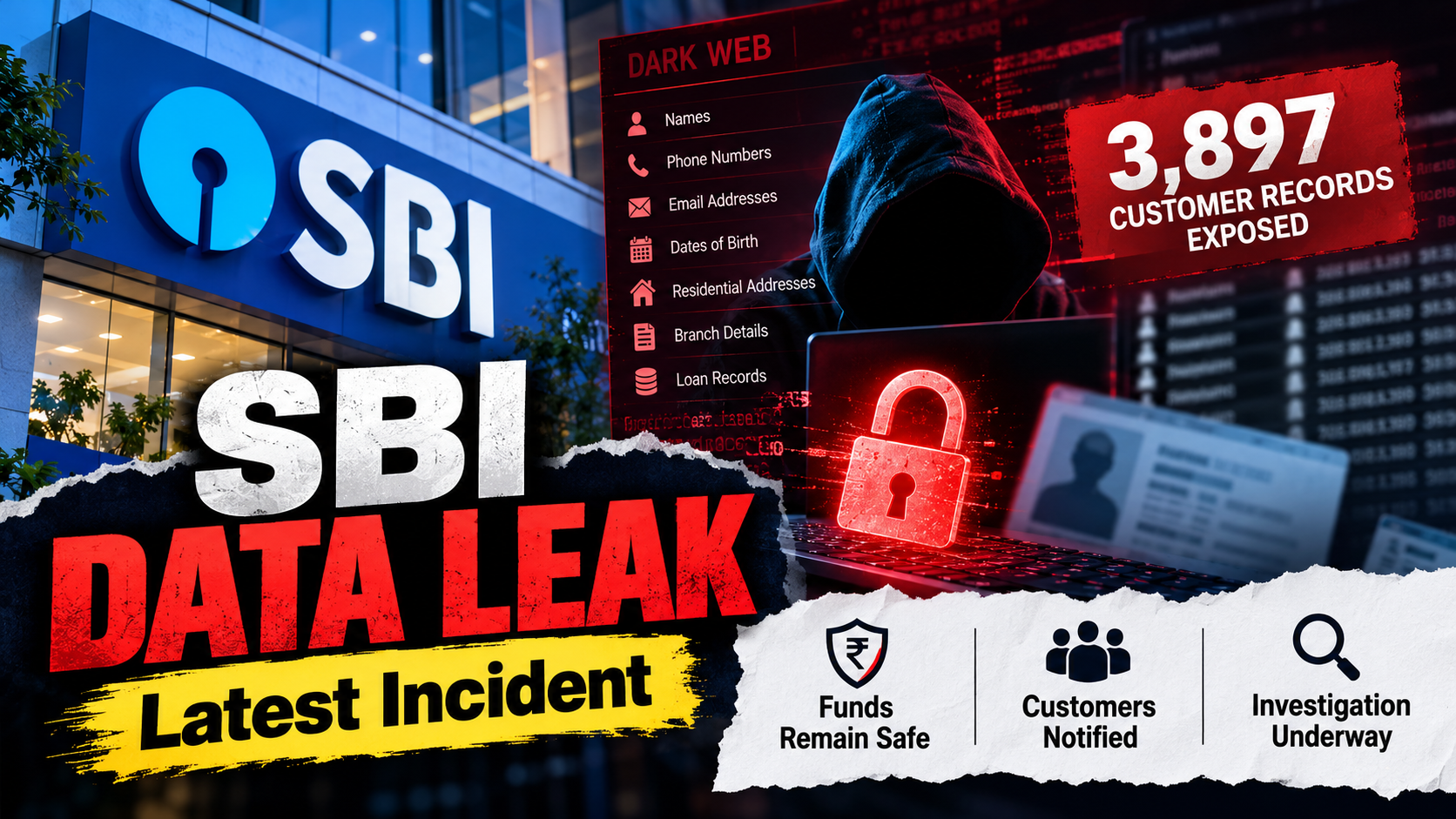
[SBI is investigating a suspected data exposure after 3,897 customer records were identified in a preliminary review. The bank says customer funds remain safe.]
State Bank of India (SBI), India's largest public sector bank, is investigating a suspected data leak after thousands of customer records containing personal information were identified in a dataset circulating on the dark web. The incident came to light in October, prompting the bank to activate its cybersecurity response procedures and appoint an independent agency to investigate what information was exposed and how it became available.
The bank's preliminary assessment identified 3,897 customer records containing personally identifiable information (PII) among approximately 3.75 lakh records examined. The exposed information reportedly includes names, mobile numbers, dates of birth, email addresses, residential addresses and identifiers associated with branches, customers and loan-related records.
On October 21, SBI disclosed the incident to the stock exchanges. Two days later, it said it had individually notified customers whose records had been identified, using email and/or WhatsApp. SBI has also reassured customers that their account balances and funds remain safe.
That reassurance is important, but it does not make the incident insignificant. Personal information can be used to create convincing phishing messages, impersonate bank employees and target customers with financial scams. The investigation must still establish the authenticity and completeness of the exposed records, the origin of the data and the full extent of the incident.
What happened in the SBI data leak?
The incident became public after information allegedly linked to SBI surfaced on the dark web. On October 16, the bank received alerts about suspected customer data exposure from its threat intelligence service provider, the Defence Cyber Agency and the Indian Computer Emergency Response Team (CERT-In).
SBI subsequently examined a dataset containing around 375,000 records. Its preliminary analysis identified 3,897 customer records containing personal information.
The bank described the incident as a loss of certain data and said that further investigation was necessary to determine the authenticity and completeness of the exposed information, its possible source and the risks associated with it.
The distinction between these figures matters. The approximately 3.75 lakh records examined should not be interpreted as 3.75 lakh confirmed affected SBI customers. The bank's initial review specifically identified 3,897 customer records containing personally identifiable information. The remaining records have not been established, in the public disclosures, as a further group of confirmed affected customers.
The investigation also needs to determine how the records left the control of the relevant organisation or service, whether the exposed material is complete, and whether additional customer information is involved.
What SBI customer information was reportedly leaked?
The information identified during the preliminary assessment includes several types of personal and customer-related data.
Information reportedly exposed | Why it matters |
|---|---|
Customer names and gender | Can help fraudsters personalise messages and impersonate customers or bank representatives |
Registered mobile numbers | Can be used for targeted calls, SMS phishing and fraudulent banking alerts |
Dates of birth | May help attackers answer weak identity-verification questions or make impersonation more convincing |
Email addresses | Can be targeted with fake account warnings, loan notices and login notifications |
Residential addresses | Can make identity-based scams more credible and expose additional personal information |
Branch and customer identifiers | Can help an attacker make a fraudulent communication appear connected to a real banking relationship |
Lead IDs and loan-related metadata | May reveal details about customer enquiries, loan applications or interactions with the bank |
The presence of multiple fields in one record can make the information more valuable to fraudsters than an isolated phone number or email address.
For example, a scammer who knows a customer's name, approximate banking relationship, branch and loan-related details may be able to construct a message that looks considerably more believable than a generic fraud alert. The recipient might recognise the details and assume that the person contacting them is a legitimate bank representative.
However, the list of reported information should not be extended beyond what has been established. SBI's initial public disclosures do not confirm that passwords, OTPs, debit-card PINs or internet-banking credentials were exposed in this incident. Nor does the published information establish that attackers accessed customers' accounts or withdrew money as a result of the leak.
The investigation is still important because the exact scope and completeness of the data exposure have not been publicly established.
Did SBI's bank accounts or customer money get hacked?
SBI has said that the incident has not materially affected its core business operations, financial performance or business continuity. Its core banking services have continued to operate normally, and the bank has reiterated that account balances and funds remain safe.
This is different from saying that no customer information was exposed. A data leak and an unauthorised transfer of money are separate events, even though stolen personal information can sometimes be used to facilitate financial fraud later.
For example, a criminal may obtain a customer's phone number and date of birth without having access to the customer's banking password. The criminal could then contact the person while pretending to be an SBI employee, claim that suspicious activity has been detected, and pressure the customer into sharing an OTP or approving a transaction.
In such a situation, the leaked information makes the fraud attempt more convincing. The criminal may not need to steal the money directly from a banking system if the victim can be manipulated into authorising a transaction.
That is why SBI's assurance about account balances should be taken alongside its warning to customers to remain alert to suspicious calls, messages and emails.
As of October 24, the public information about this incident does not establish a confirmed wave of fraudulent withdrawals caused by the leak. The bank's ongoing investigation will need to clarify the risks and whether any additional consequences emerge.
Why was the SBI data leak reported to the stock exchanges?
SBI is a publicly listed bank, and the disclosure was made under the applicable stock-exchange reporting requirements.
On October 21, the bank informed the exchanges that it had experienced an incident involving the loss of certain data. It also stated that it had activated its cybersecurity response and containment procedures and had appointed an independent cybersecurity agency empanelled with CERT-In to investigate.
The appointment of an independent agency is significant because identifying the records is only one part of the investigation. Investigators also need to establish how the information became accessible, whether the material is authentic, which systems or service providers may have been involved, and what measures are needed to prevent a recurrence.
The bank has not publicly established the technical cause of the suspected exposure in its initial disclosure. It would therefore be premature to attribute the incident to a specific vulnerability, ransomware attack, compromised employee account or third-party service.
Until the investigation provides more information, the precise route through which the data was exposed remains an open question.
How did SBI respond to the incident?
SBI activated its incident response and containment protocols after receiving the alerts on October 16. It then carried out a preliminary review of the available dataset and engaged an independent CERT-In-empanelled cybersecurity agency.
The bank's public response has focused on determining the nature and extent of the suspected data exposure while maintaining normal banking operations.
On October 23, SBI announced an additional customer-facing step: it had individually informed the customers whose records were identified during the preliminary assessment. The notifications were sent through email and/or WhatsApp, and the bank reiterated that the customers' funds and account balances remained safe.
The notification update is relevant because customers were initially left waiting for clarity about whether the information associated with them had been identified. It does not, however, mean the investigation is complete. The bank still needs to determine the full extent of the incident and any additional risks.
Customers should also remember that a genuine security incident can create an opportunity for scammers to spread fake notifications. An email or WhatsApp message claiming to be about the SBI data leak should not automatically be trusted just because it mentions the incident.
What should SBI customers do now?
Even if you have not received a notification from SBI, basic precautions are worthwhile. The most important step is to be particularly careful about anyone who contacts you unexpectedly while claiming to be from the bank.
Be suspicious of calls about leaked banking information
A caller may know your name, mobile number, branch or other personal details and use them to appear legitimate. Those details are not proof that the caller works for SBI.
Do not share an OTP, PIN, internet-banking password, UPI PIN or other authentication information over a call. A person claiming to be a bank employee should not need you to reveal these confidential credentials.
If a caller insists that your account will be blocked unless you act immediately, end the call and contact the bank through an independently verified channel.
Check notifications without clicking suspicious links
If you receive an email or WhatsApp message claiming that your information was involved in the SBI data leak, check it carefully. Avoid opening unexpected attachments, downloading applications or following payment links supplied in the message.
Use SBI's official website, official banking app or the contact information provided through your existing banking documents to verify the communication. You can also contact your branch directly.
Do not reply with identity documents or confidential banking details simply because a message uses the bank's name or logo.
Keep an eye on transactions and account alerts
Review your account activity and take notice of unfamiliar transactions, unexpected payment requests or changes you did not authorise. Keep transaction alerts enabled where available.
Although the reported data exposure does not establish that customer accounts were accessed, regular monitoring can help you notice suspicious activity promptly.
If you discover an unauthorised transaction, contact your bank immediately through its official reporting channel. In India, suspected cyber financial fraud can also be reported through the National Cyber Crime Reporting Portal or the cybercrime helpline at 1930. Prompt reporting may be important when a fraudulent transfer has occurred.
Change credentials if there is a specific reason to suspect compromise
The public disclosure does not establish that SBI passwords or OTPs were exposed. Customers should not assume their login details were stolen simply because the bank reported a data leak.
However, if you have reused a password, clicked a suspicious link, shared credentials with someone, or noticed an unfamiliar login or transaction, take appropriate action. Change compromised passwords through the official banking channel, secure your registered email account and contact the bank if your account may be at risk.
Never use a password-reset link supplied by an unverified caller or message.
What remains unknown about the SBI data breach?
Several important questions remain unanswered publicly.
How did the information get out? The bank's initial disclosure does not establish the source of the suspected exposure. A detailed technical investigation is needed before attributing it to a particular system, employee, service provider or attack method.
Is the dataset complete and authentic? SBI has said a further assessment is required to establish the authenticity and completeness of the exposed material. The preliminary figure may not represent the final scope of the investigation.
Were any other sensitive documents involved? Reports surrounding the incident have included claims about a larger collection of files. The bank's initial disclosure does not establish that every document described in those claims was authentic, belonged to SBI customers or was confirmed as exposed.
Were customer credentials or funds compromised? SBI has said customers' account balances and funds remain safe. The publicly reported information does not establish that banking passwords, OTPs or PINs were exposed, or that money was stolen because of this incident.
These questions should be answered through the investigation rather than speculation. Until then, it is important to distinguish the records identified in SBI's preliminary analysis from claims about the broader dataset.
The bigger concern is what criminals can do with personal data
The SBI incident shows why a data leak can create risks even when no direct loss of money has been reported.
Names, addresses, phone numbers and customer identifiers can be combined to make phishing campaigns more targeted. A fraudster might claim to be following up on a loan application, verifying a branch-related issue or helping with an account-security problem. If the message contains accurate personal information, the recipient may be more inclined to trust it.
This is one reason financial data needs protection beyond passwords and transaction systems. Personal information can provide the context needed to manipulate customers, bypass weak identity checks or make fraudulent requests seem genuine.
For banks, an effective response involves more than confirming that banking services remain online. It also requires establishing how information was exposed, limiting further access, assessing the affected records and communicating clearly with customers.
For customers, the sensible response is neither to panic nor to ignore the incident. It is to understand the difference between exposed personal information and confirmed access to money, while remaining alert to attempts at impersonation.
Authors
Want To Read Similar Posts
RELEASED DATE: 13 August 2026
READ TIME: 6 Minutes Read
Online Scam Alerts, Phishing and Deepfake Awareness: How Digital Scams Are Changing in 2026
See how phishing, deepfake and AI-powered scams work in 2026. Discover warning signs, latest fraud trends and practical tips to protect your identity and money.