
Online Scam Alerts, Phishing and Deepfake Awareness: How Digital Scams Are Changing in 2026
RELEASED DATE: 13 August 2026
6 Minutes Read
The internet has made banking, shopping, communication and business faster than ever. At the same time, online fraud has become more convincing, more personal and increasingly difficult to identify at first glance. In 2026, the biggest change is not simply that scammers are creating more fake websites or sending more suspicious messages. They are increasingly using artificial intelligence to make those scams look and sound legitimate.
This matters because the traditional signs of a scam are becoming less reliable. A message may contain perfect grammar, a phone call may sound exactly like someone you know, and a video may appear to show a real person saying something they never actually said.
Recent data shows how serious the problem has become. The FBI's 2025 Internet Crime Report recorded more than 1 million complaints in the United States, with reported losses approaching $21 billion. Phishing and spoofing were among the most frequently reported complaints, while investment scams remained one of the largest sources of financial losses. For the first time, the report separately tracked artificial-intelligence-related complaints and recorded 22,364 such complaints associated with nearly $893 million in reported losses.
The situation is also relevant to India. Recent government data reported in August 2026 showed that CERT-In detected and mitigated almost 3.5 lakh instances of malicious scanning, probing and vulnerable services targeting the finance sector during January to June 2026. The figure for the first six months was already a substantial share of the total recorded throughout 2025. Healthcare also recorded 18,855 such instances during the same period.
Phishing Is No Longer Just a Suspicious Email
Phishing traditionally meant receiving an email that tried to trick someone into revealing a password, card number or login information. Today, the same technique appears across almost every digital channel.
A scam may arrive through WhatsApp, SMS, social media, a phone call, a fake customer-support conversation or a website that looks almost identical to the real service. The objective is usually the same: create enough trust or urgency for the victim to act before checking whether the request is genuine.
Artificial intelligence has made this process easier for criminals. Google Threat Intelligence has reported that threat actors are experimenting with AI for activities including reconnaissance and phishing-lure creation. It has also observed underground markets offering AI-related tools for phishing and other malicious activities.
This means spelling mistakes and obviously unnatural messages can no longer be treated as the main warning signs. A professionally written message can still be fraudulent.
The Rise of AI-Powered Impersonation
One of the most concerning developments is the use of AI to imitate people.
A scammer can create a fake social-media profile using publicly available photographs. They can generate a convincing voice from a short audio recording. In more advanced cases, manipulated or generated video can make a person appear to speak or behave in a way that never happened.
The FBI reported that criminals were using fake social profiles, voice clones, forged identification documents and believable videos depicting public figures or loved ones in their scams. The agency specifically warned people to resist pressure and take time to verify unexpected requests.
This is where deepfake awareness becomes important.
A deepfake is digitally manipulated or AI-generated media that can make a person appear or sound different from reality. Not every manipulated video is created for fraud, but scammers can use the technology to impersonate relatives, company executives, government officials, celebrities and financial professionals.
A common example is an urgent call supposedly coming from a family member. The caller may claim that there has been an accident, a legal problem or another emergency and immediately ask for money. The voice can sound familiar enough to bypass a person's normal suspicion.
The safest response is not to argue with the caller. End the conversation and independently contact the person through a number or communication method you already trust.
Why Deepfake Scams Are Particularly Dangerous
The greatest strength of a deepfake scam is not the technology itself. It is the emotional pressure surrounding it.
Scammers understand that people make different decisions when they believe a family member is in danger, a bank account is about to be frozen or a business payment must be completed immediately.
This technique has existed long before generative AI. Artificial intelligence simply makes impersonation cheaper, faster and more convincing.
Recent research also suggests that real-world deepfake harms are increasingly associated with voice-clone scams and emotional manipulation rather than only the dramatic fake celebrity videos that often receive public attention.
That shift is important because an ordinary person does not need to encounter a sophisticated fake video to become a victim. A convincing voice call may be enough.
Fake Customer Support Is Another Growing Risk
People searching for support numbers online can also become targets.
A scammer may create a fake customer-support page, advertisement or social-media account that appears to belong to a bank, payment service, shopping platform or technology company. The victim contacts the fake account and is then instructed to share an OTP, install remote-access software, transfer money or reveal sensitive account information.
The problem becomes even more difficult when the scammer already knows basic details about the victim. Information from social media, leaked databases or previous interactions can make the conversation sound authentic.
A legitimate support representative should not require you to surrender passwords, move money to a so-called “safe account” or give an OTP that you received for your own transaction.
Investment Scams Remain Extremely Costly
Scammers have also become increasingly skilled at making fake investment opportunities look professional.
They may advertise through social media, create fake investment dashboards, place victims into messaging groups or impersonate analysts and financial experts. Some schemes show fabricated profits to convince the victim that the platform is working.
The FBI's 2025 data shows why investment scams deserve particular attention. Investment fraud accounted for nearly half of the reported scam-related losses in its cybercrime data. Cryptocurrency-related complaints alone exceeded 181,000 and involved more than $11 billion in reported losses.
The lesson is simple: a professional website, convincing app or profitable-looking dashboard does not prove that an investment opportunity is legitimate.
How to Recognise an AI-Enhanced Scam
There is no single visual clue that can reliably identify every AI-generated scam. The better approach is to examine the behaviour of the request.
Unexpected urgency is one of the strongest warning signs. Be cautious when someone tells you that you must transfer money immediately, share a verification code, click a link immediately or keep the conversation secret.
Another warning sign is an unusual request from someone you normally trust. Even when the voice, profile picture or video appears genuine, independently verify the request before sending money or sensitive information.
Links should also be treated carefully. Instead of opening an unexpected link from a message, manually open the official website or application and check the information there.
Most importantly, never treat a familiar voice or face as proof of identity.
What You Should Do After Receiving a Suspicious Message
Do not respond immediately. Take a moment to examine the request.
Do not provide OTPs, passwords, banking credentials or card details through an unsolicited conversation.
Do not install software because an unknown caller claims it is required to fix your account.
Do not transfer money simply because someone creates a sense of emergency.
Verify the person or organisation using an independently obtained phone number, website or official application.
If money has already been transferred, contact the relevant bank or financial service immediately and preserve the messages, transaction details, phone numbers, usernames and other evidence.
For cybercrime incidents in jurisdictions where the appropriate reporting channel is available, reporting quickly can improve the chances of investigation and recovery. The FBI, for example, advises victims to document contact information, dates, payment methods and transaction details when reporting fraud.
Businesses Face a Larger Problem
Online scams are no longer only a consumer problem. Businesses are increasingly exposed to impersonation, compromised email accounts, fraudulent invoices and AI-assisted social engineering.
An attacker may impersonate a supplier and request that a payment account be changed. Another may impersonate an executive and ask an employee to purchase gift cards or transfer funds. A convincing voice clone can make such a request appear even more credible.
For this reason, businesses should avoid relying entirely on email identity. Sensitive requests should have a second verification process.
A company can create a simple rule: payment-account changes, unusually large transfers and other high-risk requests must be confirmed through a separate trusted communication channel.
This small process can prevent a surprisingly large number of successful scams.
The New Rule for Digital Safety
The old approach to online safety was often based on spotting obvious mistakes. The new approach needs to be based on verification.
A message can be grammatically perfect and still be fake.
A website can look professional and still be fraudulent.
A phone call can sound exactly like someone you know and still be generated or manipulated.
A video can appear authentic and still be fabricated.
As AI tools become easier to access, the ability to create convincing deception will continue to increase. Google has already documented threat actors experimenting with AI-assisted phishing and other malicious operations, while the FBI's latest report shows that AI-related scams are producing substantial financial losses.
The safest habit in 2026 is therefore simple: slow down, verify independently and never allow urgency to replace verification.
Technology is becoming better at imitating people. Digital safety now depends on becoming better at verifying them.
Authors
Want To Read Similar Posts
RELEASED DATE: 24 October 2026
READ TIME: 7 Minutes Read
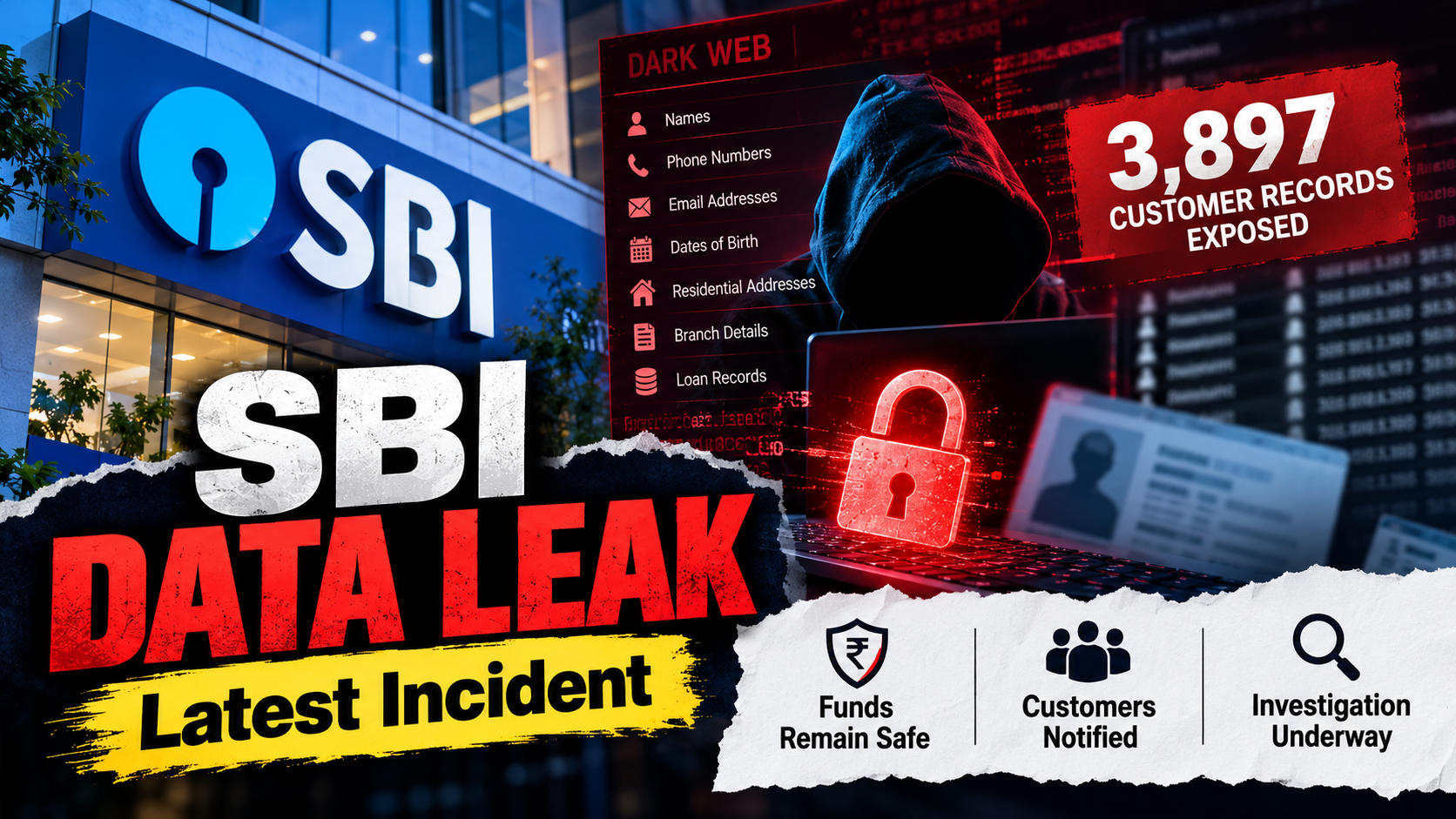
SBI Data Leak: 3,897 Customer Records Found Exposed on the Dark Web, Bank Says Funds Are Safe
SBI Data Leak 2026: 3,897 customer records identified, details of the reported exposure, the bank's response and safety tips for customers.

RELEASED DATE: 24 October 2026
READ TIME: 14 Minutes Read
October 2026 Security Alert: eMudhra Certificate Compromise, Node.js Vulnerabilities and PHP2Shell
October 2026 security alert: Learn about the eMudhra certificate compromise, Node.js vulnerabilities, PHP2Shell, patched versions and fixes.

RELEASED DATE: 17 October 2026
READ TIME: 7 Minutes Read
Tesla’s New Flying Car: Roadster 2, Features, Price, Launch Date and What Makes It Different
Explore Tesla's new flying car, the next-generation Roadster, its features, thruster technology, expected price, performance and launch date.

RELEASED DATE: 10 October 2026
READ TIME: 5 Minutes Read
US Suspends 8 Tech Firms From PERM: Full List and Impact
The US has suspended PERM processing for eight tech firms, including Microsoft, TCS and Infosys. Here's the full list and impact on green card applicants.

RELEASED DATE: 3 October 2026
READ TIME: 6 Minutes Read
What Documents Are Required to Sell a Property in Dubai?
Learn which documents are required to sell a property in Dubai, including title deeds, NOCs, mortgage papers, and legal requirements for sellers.

RELEASED DATE: 29 September 2026
READ TIME: 4 Minutes Read
Yo Yo Honey Singh Introduces Casa Tupka Tequila With New Music Release
Yo Yo Honey Singh launches Casa Tupka, a premium tequila brand made in Mexico, alongside his new music release Casa Tupka Anthemo.